 how-to
How to Stop Dust from Draining Solar Energy Output
Last Updated: October 30, 2026
Quick Summary
Solar dust blocks sunlight from reaching the photovoltaic cells, cutting light transmission and reducing power output. Losses grow the longer glass goes uncleaned and the dirtier the local air is, and they vary widely by site, climate, and cleaning history. Checking your own production data is the most reliable way to measure the impact.
- Soiling hits production through transmission loss, mismatch and string losses, thermal effects, and compounding deposition.
- Record daily production for 5-7 clear days right after cleaning to establish a clean baseline.
- Clean with soft tools and plain water early in the morning when panels are cool.
- Never use a pressure washer or scrub dry glass, because grit acts like sandpaper.
- Panels near farmland or open dirt may need cleaning every 3-4 months.
Table of Contents
- How Dust Settles on Panels and Blocks Sunlight
- Dust on Solar Panels Energy Loss: What the Numbers Show
- Monitoring Solar Panel Output to Catch Soiling Early
- How to Clean Dust Off Solar Panels Safely
- How Often to Clean Solar Panels in Northern California
- When Professional Cleaning Pays for Itself
- Book a Cleaning and Get Your Output Back
- Frequently Asked Questions
How Dust Settles on Panels and Blocks Sunlight
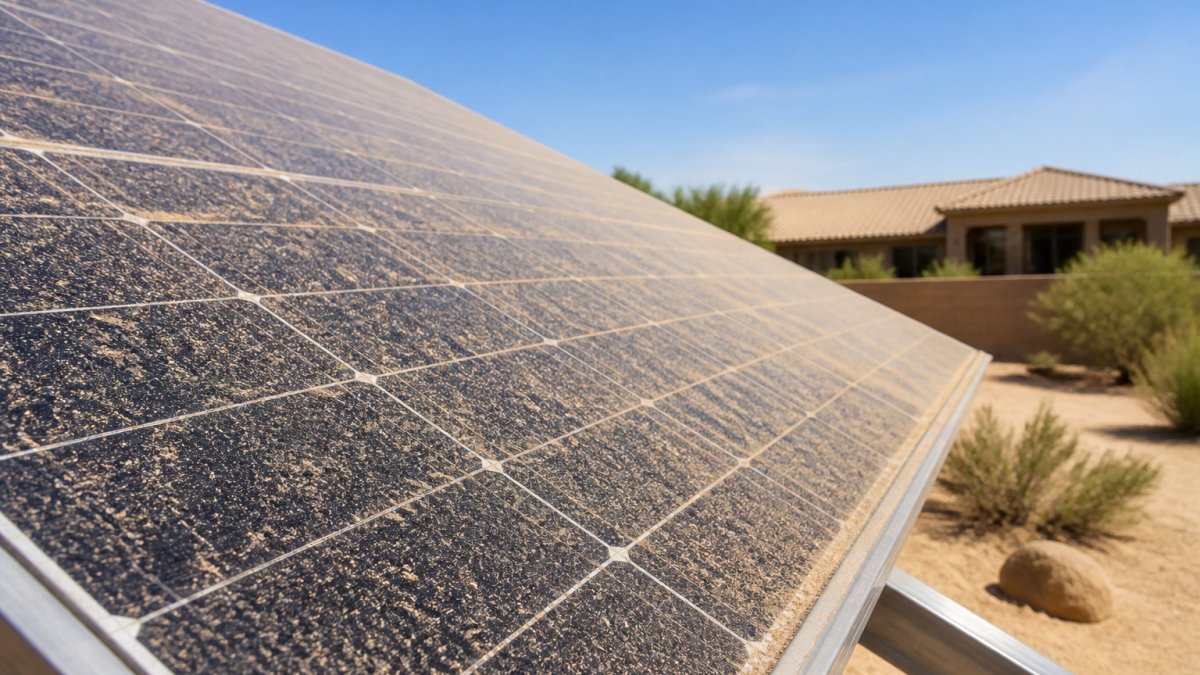
Solar dust accumulation on panels is the gradual buildup of airborne particles that settles on panel glass and blocks sunlight from reaching the cells beneath. A thin film of dust can look harmless but quietly cuts into production.
Here is how it happens. Wind lifts soil, pollen, smoke, and road grit into the air. When that air slows near a panel surface, particles drop out and stick. Rain sometimes washes them off. In dry stretches, nothing does.
The physics is simple. Sunlight must pass through the glass to reach the photovoltaic cells. Every particle on that surface scatters or absorbs light before it arrives. More dust means less light transmission, and less light means less power.
Solar dust does not build up evenly, either. It collects along frame edges, in lower corners, and around mounting hardware. Bird droppings add stubborn spots that block light far more than a uniform film does.
Dust on Solar Panels Energy Loss: What the Numbers Show
Dust on solar panels can meaningfully reduce energy output, and losses tend to grow the longer glass goes uncleaned and the dirtier the local air is. Exact losses vary widely by site, climate, and cleaning history, so checking your own production data is the most reliable way to measure the impact.
These are ranges, not guarantees. The exact number for your roof depends on your dust load, your tilt, your rainfall, and your cleaning history.
The Four Mechanisms Behind the Loss
Soiling does not just 'block light' in a single way. It hits production through four distinct channels:
- Transmission loss. Every particle on the glass scatters or absorbs photons before they reach the photovoltaic cells. A uniform film cuts current proportionally across the whole array.
- Mismatch and string losses. Solar cells are wired in series, so current is limited by the weakest cell in the string. A bird dropping or a clump of leaves on one panel can affect the output of other panels wired with it.
- Thermal effects. A dark dust layer absorbs heat that would otherwise pass through the glass. Higher cell temperature reduces open-circuit voltage, so a soiled panel can run hotter and produce less even under identical sunlight.
- Compounding deposition. Dust does not stay static. Particles attract moisture and more particles, and the layer can thicken over time if nothing removes it.
How to Measure Losses on Your Own System
Your own production data matters most. You can estimate soiling loss without lab equipment by following a repeatable method:
- Establish a clean baseline. Right after a cleaning, record daily production for 5-7 clear days. Note irradiance conditions (clear sky, similar temperature) so the comparison is fair.
- Track daily production against weather. Use your inverter monitoring app or the manufacturer's portal. Log date, sky condition, and kWh produced.
- Watch for the drift. A slow decline on clear days, while weather stays comparable, is the signature of soiling. A sudden step-down points to equipment, not dust.
- Normalize for weather. Compare only clear-sky days to clear-sky days. Cloudy or hazy days will muddy the signal.
- Confirm with a visual check. Look at the glass from the ground after a dry stretch. A dull, hazy surface confirms the data.
- Clean and re-measure. Compare the post-cleaning week to your baseline. The difference, multiplied by your electric rate, is your recovered value.
A simple log, date, weather, kWh, turns a vague worry into a number you can act on. If the drift is small and rain keeps resetting it, you can wait. If the drift is steady and steep, cleaning may be worth scheduling.
Monitoring Solar Panel Output to Catch Soiling Early
Monitoring solar panel output is a practical way to tell whether dust may be affecting your production. Compare today's production against what your system made on a clear day weeks ago, under similar sun.
Watch for these signals:
- Output drops on clear days while weather stays the same.
- One string underperforms its neighbors.
- Production recovers sharply right after a rainstorm.
- Your inverter app shows a slow downward drift over weeks.
Keep a simple log. Note the date, the weather, and the daily production number. A pattern becomes obvious fast.
Watch out: do not blame every dip on dust. Shade from new tree growth, a failing inverter, or a tripped breaker can look identical in the numbers. Check the easy causes first.
How to Clean Dust Off Solar Panels Safely
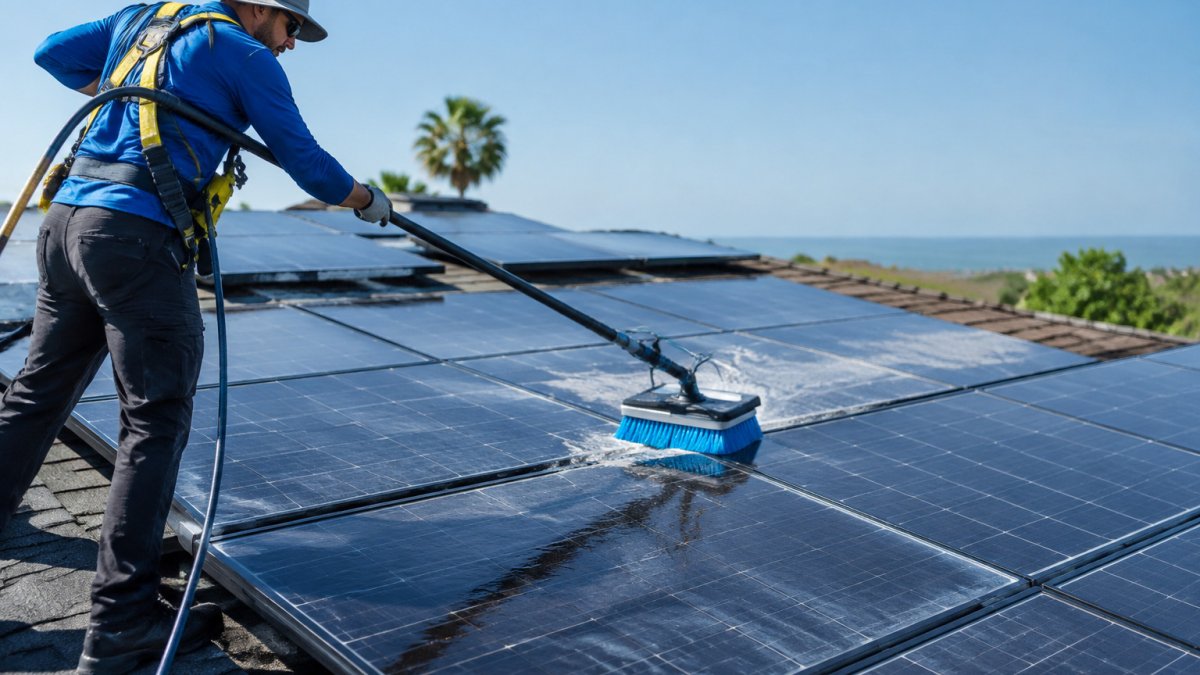
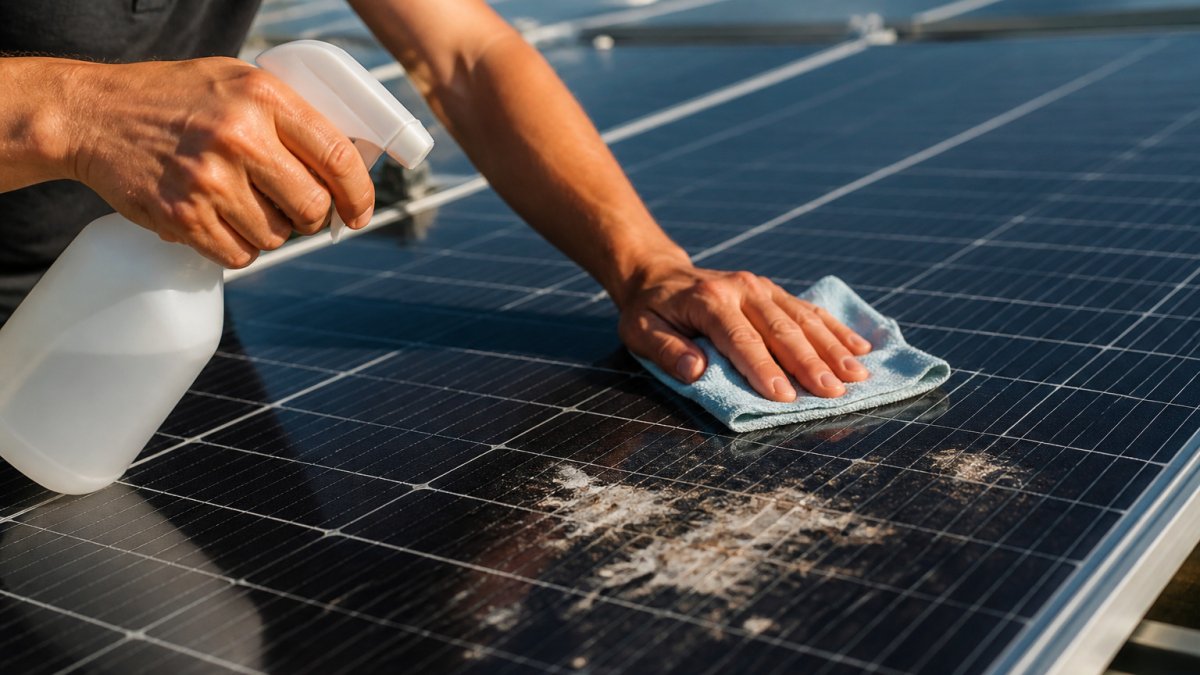
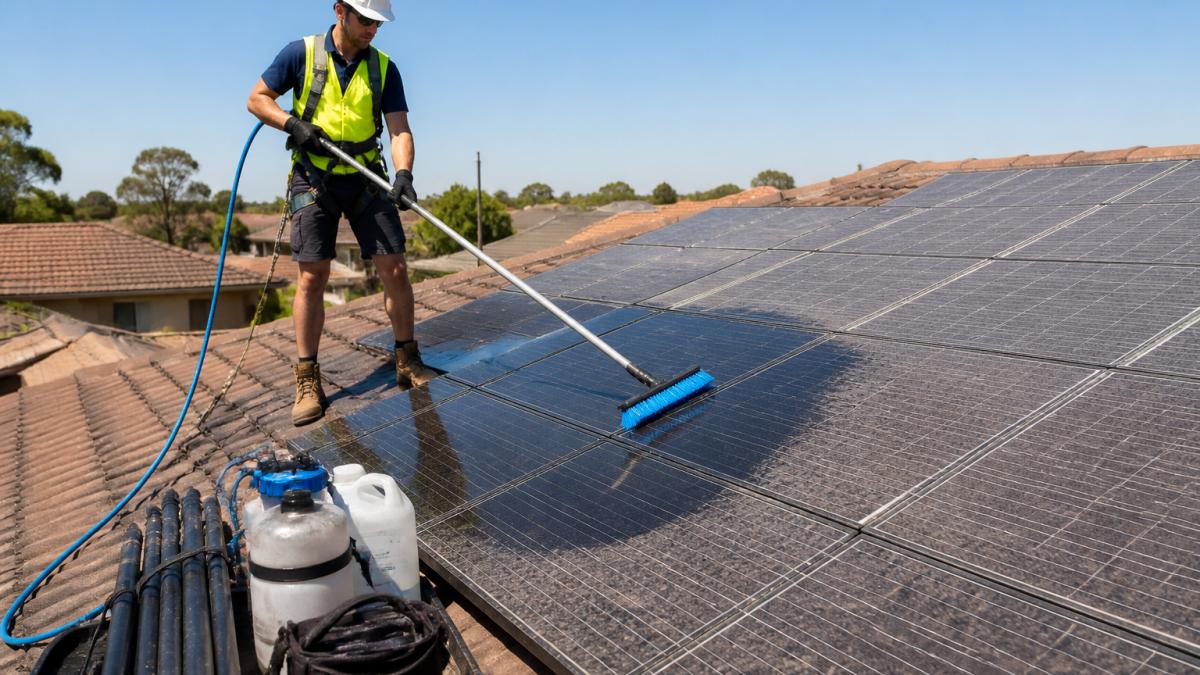
The safe way to clean dust off solar panels is with soft tools, plain water, and no pressure. Work early in the morning when panels are cool. Hot glass plus cold water can stress the modules.
Follow this sequence:
- Shut down if your manual requires it. Many systems need no shutdown, but check yours.
- Inspect first. Look for cracks, loose wiring, or damaged glass. Stop if anything looks wrong.
- Rinse loose dust. Use a garden hose with a gentle spray, no nozzle pressure.
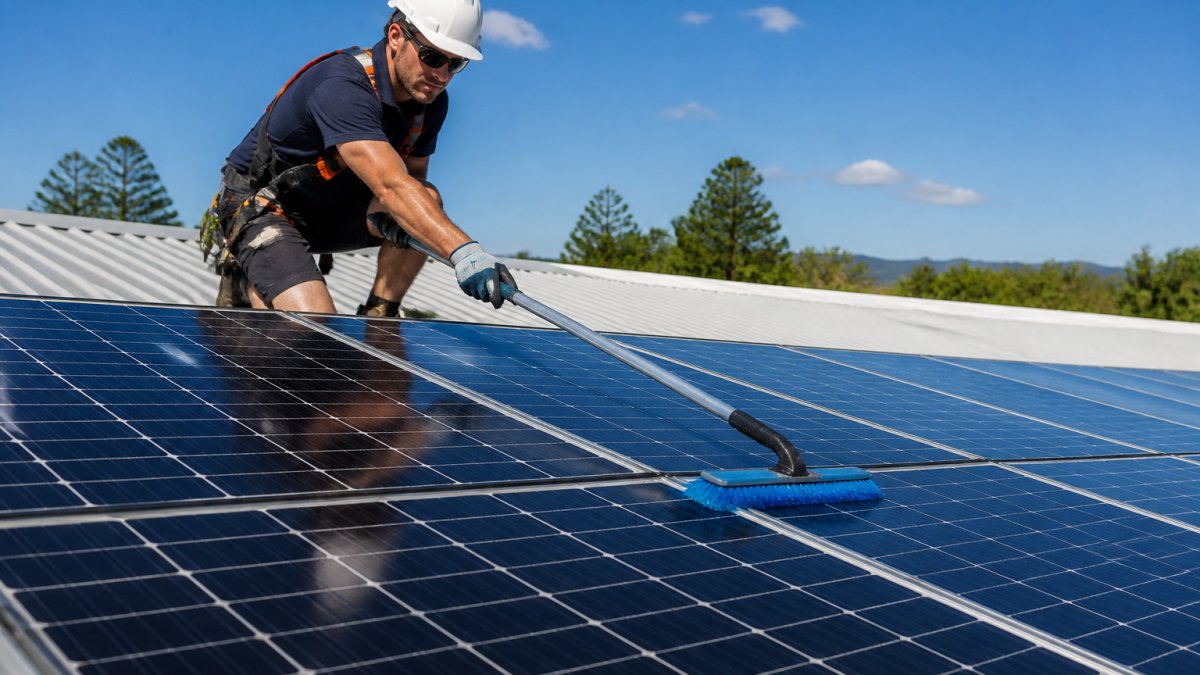
- Wash with a soft brush. Use a soft-bristle pole brush and plain water. Skip abrasive pads entirely.
- Work top to bottom. Let gravity carry dirty water away from clean areas.
- Rinse again. Remove every soap or mineral streak before it dries.
- Squeegee or air-dry. A soft squeegee prevents water spots.
Two rules keep you out of trouble. Never use a pressure washer, which can force water past seals and void warranties. Never scrub dry glass, because grit acts like sandpaper.
Mr Clean Solar Cleaning uses purified deionized water and soft-bristle systems built for solar glass.
How Often to Clean Solar Panels in Northern California
How often to clean solar panels depends on what lands on them. Cleaning frequency depends on local conditions, dust load, and rainfall. Properties near farmland, open fields, or busy roads may need more frequent attention.
Use this as a starting point:
| Situation | Suggested Frequency | Why |
|---|---|---|
| Suburban roof, mild dust | Once a year | Rain does most of the work |
| Near farmland or open dirt | Every 3-4 months | High airborne particle load |
| Heavy bird activity | Every 2-3 months | Droppings block light and stain glass |
| Commercial rooftop array | Quarterly, with reports | Output tracking and ROI protection |
| Visible film or streaking | As soon as seen | Early action limits losses |
A practical test: look at your panels from the ground after a dry month. If the glass looks dull rather than dark and reflective, it is time.
When Professional Cleaning Pays for Itself
Professional cleaning pays for itself when the recovered energy value exceeds the service cost. That math works best for larger arrays, heavy soiling, and systems with steep electricity rates.
Run the numbers on your own system:
- Note your daily production before cleaning.
- Get the panels cleaned.
- Compare production over the next week of similar weather.
- Multiply the recovered kilowatt-hours by your electric rate.
If the gain repeats monthly, cleaning is a sound investment. If your panels were barely soiled, the gain will be small, and that is useful information too.
Professional service also covers what DIY may miss. Mr Clean Solar Cleaning's team is OSHA-trained and fully insured, and provides detailed performance reports.
One customer reported their energy bill dropped by $45 a month after cleaning. A warehouse client with 200+ panels reported a 28% ROI improvement. Results vary by site.
Book a Cleaning and Get Your Output Back
Dust is the quietest cost on a solar system. It never sends an alert. It just shaves a little off every sunny day, month after month, until the loss is normal.
The fix is straightforward. Measure your output, clean safely, and set a schedule that matches your site. If you would rather hand it to specialists, Mr Clean Solar Cleaning can help.
Mr Clean Solar Cleaning brings certified solar maintenance specialists, an OSHA-trained and fully insured team, and soft-bristle systems designed for solar glass. We provide detailed performance reports. We have cleaned 50,000+ panels and hold a 5.0 rating.
Get started with Mr Clean Solar Cleaning and put your panels back to peak efficiency.
Frequently Asked Questions
How much energy can dirty solar panels lose?
Output loss depends on how thick the dust layer is, the particle size, and local weather. In dusty, arid conditions, heavy soiling can cut production noticeably, while light dust in a wetter climate causes a smaller hit. Rain helps rinse some dust away but rarely clears the film that builds up over months. The only way to know your actual loss is to compare current output against your system's clean baseline, which is why monitoring and before-and-after readings matter.
Does rain remove dust from solar panels?
Rain removes some loose dust but leaves behind a film of fine particles, pollen, and bird droppings that water alone cannot lift. In Northern California, long dry stretches let dust accumulate between storms, and the first rain often just turns it into streaks. Panels that look clean from the ground can still carry a light haze that blocks sunlight. A proper cleaning with deionized water and soft bristles removes that layer instead of spreading it around.
How can I tell if dust is reducing my solar energy production?
Check your inverter or monitoring app for a drop in daily output that is not explained by shorter days or heavy cloud cover. Compare the same month year over year, and look for a slow decline rather than a sudden failure. A visual inspection from a safe distance helps too: a dull gray haze, pollen streaks, or droppings mean soiling is present. If output is down and the panels look dirty, cleaning is the first thing to rule out before assuming equipment trouble.
Is it safe to clean solar panels myself?
You can rinse panels from the ground with a garden hose, but climbing on a roof carries real fall risk and pressure washing can crack glass or force water behind the frame. Abrasive pads and hard water leave scratches and mineral spots that permanently reduce light transmission. Professional crews such as Mr Clean Solar Cleaning's OSHA-trained team use soft-bristle systems and purified deionized water. For anything beyond a light rinse, hiring a certified solar maintenance specialist is worth considering.