 comparison
7 Premier Solar Cleaning Alternatives Compared on Cost and Service
Last Updated: November 4, 2026
Quick Summary
Solar cleaning alternatives include quote-based professional services, DIY cleaning, local handymen and commercial maintenance contracts, each suited to different system sizes and budgets. Premier-style providers suit most homes, while DIY works best for easy-access, low-slope roofs. Compare written quotes before you book.
- Ask every provider for a written quote covering per-panel rate, minimums, travel fees and water.
- DIY cleaning suits ground-mounted arrays and single-story low-slope roofs reachable from a stable ladder.
- Hire a professional for steep or high roofs and tile or metal roofs that are easy to damage.
- DeionizedDeionized water and non-abrasive methods help protect panel glass and warranty terms.
- Commercial sites should compare per-visit pricing, annual contracts and performance-based agreements.
Table of Contents
- How Much Is Solar Panel Cleaning in the US?
- Quick Comparison of Solar Cleaning Alternatives
- Evaluating Solar Panel Cleaning Companies
- DIY vs. Professional Cleaning: Cost-Benefit Analysis
- Commercial Solar Panel Cleaning Options
- Choosing Your Next Step: Booking a Cleaning Quote
- Frequently Asked Questions
Searching for solar cleaning alternatives is a sensible move when your current service is costly, hard to schedule, or not covering the panels you own. This guide from Mr Clean Solar Cleaning compares seven options so you can judge cost and service before you book anything. Many homeowners and property managers in Northern California start this search after a few months of dust, pollen and bird droppings have quietly cut output.
Most of the reasons people switch come down to three things: price transparency, how quickly a crew can arrive, and whether the provider works on your type of system. A residential roof with a dozen panels has different needs from a warehouse with hundreds. Knowing which of those matters to you narrows the list fast.
Below, we walk through the real cost questions, a side-by-side comparison, and a checklist for evaluating any provider. We also cover the DIY route, because for some roofs it is a reasonable first step.
How Much Is Solar Panel Cleaning in the US?
Solar panel cleaning cost in the US varies with system size, roof access and whether the work is residential or commercial. Pricing depends on system size, roof access and whether the work is residential or commercial. Commercial work is usually quoted per site. Mr Clean Solar Cleaning's current prices are available from a quote request on its website.
Ask every provider for a written quote that states the per-panel rate, minimums, travel fees and whether water is included. That single step prevents most surprises.
Quick Comparison of Solar Cleaning Alternatives
The table below summarizes what each option publishes about pricing and service. Where a provider does not list a figure, we say so rather than guess.
| Provider | Published Pricing | Best For | Main Limitation |
|---|---|---|---|
| Mr Clean Solar Cleaning | Quote-based; contact us | Homes and large solar farms | Pricing is not listed online |
| SolarIQ USA | National average $150-$350 per visit | Homeowners comparing costs | No company-specific quote shown |
| DronePower1 | $9.00/panel, $150 minimum (residential) | Residential and commercial per-panel comparison | Commercial pricing is per site |
| All One Solar Shine | Not listed | Pricing-focused research | No service list or price shown |
| DIY cleaning | Your time plus supplies | Easy-access, low-slope roofs | Safety and warranty risk |
| Local handyman | Varies by area | Small residential jobs | Often lacks solar-specific equipment |
| Commercial maintenance contract | Quoted per site | Warehouses and large arrays | Requires a longer commitment |
Evaluating Solar Panel Cleaning Companies
When you compare solar panel cleaning companies, focus on five checks: insurance, training, method, reporting and written terms. Ask whether the crew carries liability insurance and workers' compensation (DBA Information). Ask how they clean, because pressure washing and harsh chemicals can scratch glass or affect warranty terms.
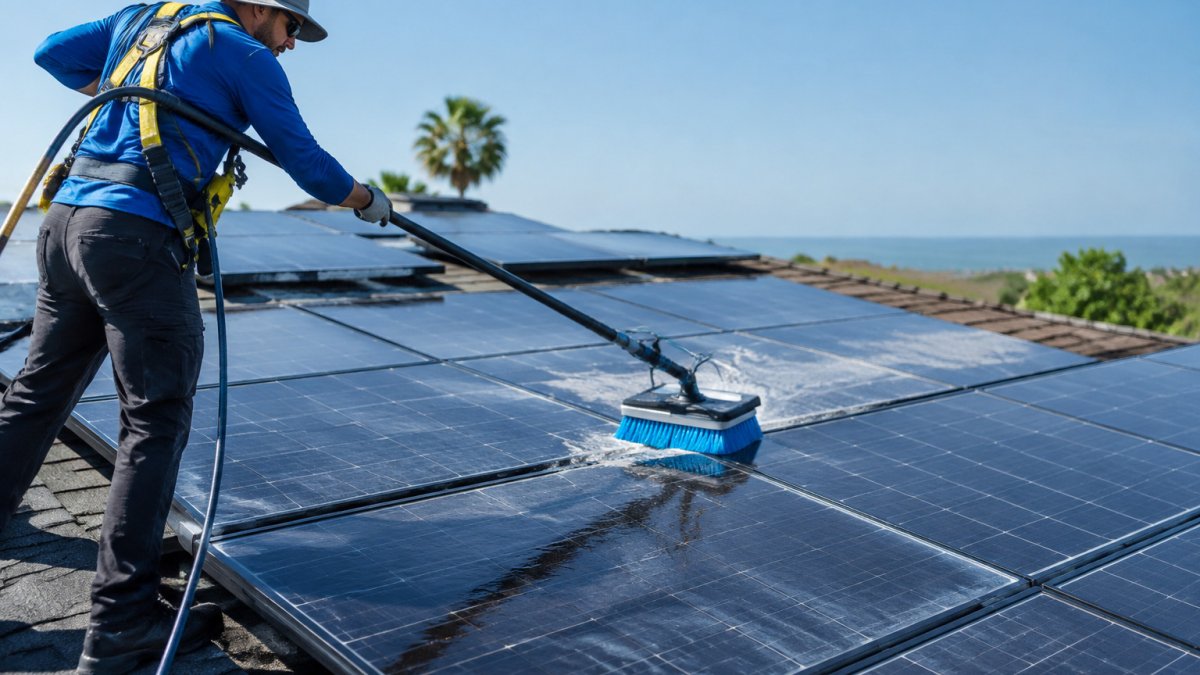
Mr Clean Solar Cleaning uses ultra-pure deionized water and zero abrasive chemicals, is fully insured, and has an OSHA-trained team.
Ask for references from customers with a similar system. A reference from a homeowner with six panels tells you more than a reference from a 500-panel farm, and the reverse is true for commercial buyers.
DIY vs. Professional Cleaning: Cost-Benefit Analysis
Most solar cleaning pages are service pages that assume you will hire someone. This section takes the neutral view: when does DIY actually save money, and when does it cost more than it saves? The answer depends on roof access, panel count, water quality and warranty terms, not on a single price tag.
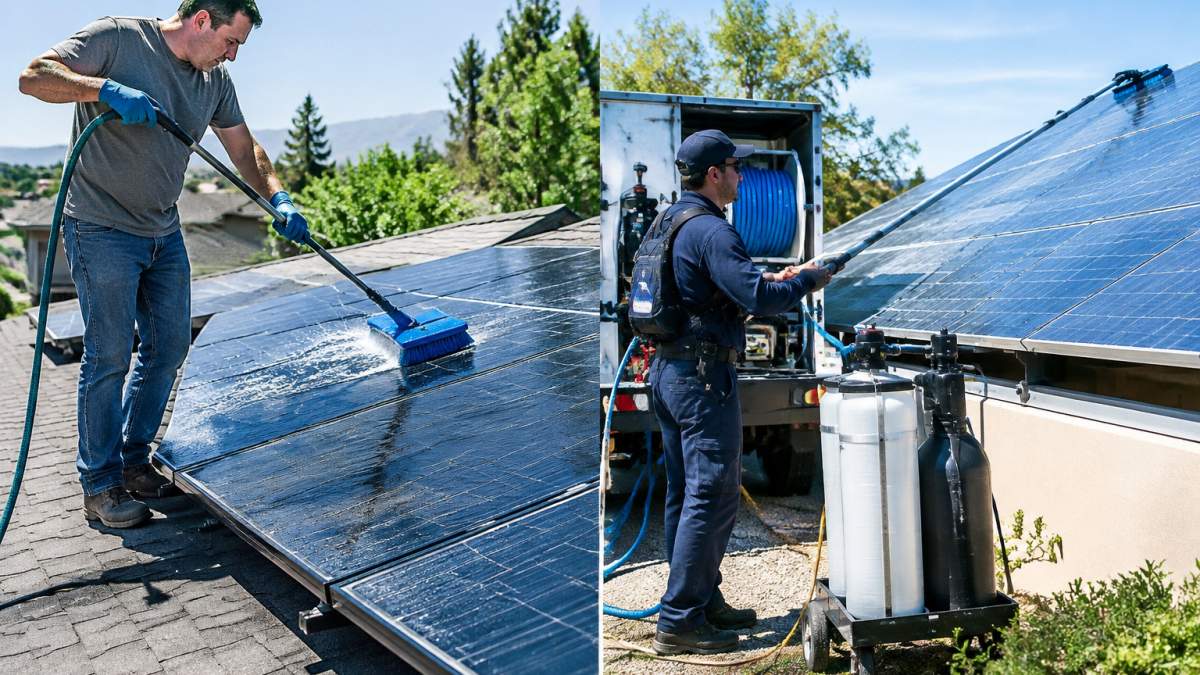
Start with the real out-of-pocket cost of DIY, which includes your own time, basic cleaning tools and, if your tap water is hard, a water filter or rinse cartridge.
Now compare that to a professional visit. If you clean twice a year, DIY supplies can pay for themselves over a few seasons, but only if your roof is safe to access and your water is filtered.
Watch out: the savings disappear fast if you scratch a panel. Replacing a damaged module can be costly, and pressure washing or abrasive pads can affect the manufacturer's warranty. Most panel warranties require cleaning with non-abrasive methods and forbid high-pressure spray, so check your owner's manual before you buy any brush.
The safety math matters just as much. Falls are the leading cause of home-injury deaths in the U.S., and roof work is a common trigger. If your array is on a steep pitch, above one story, or set back from the eave, the fall risk alone usually justifies hiring a crew that carries liability insurance and workers' compensation.
A practical decision rule:
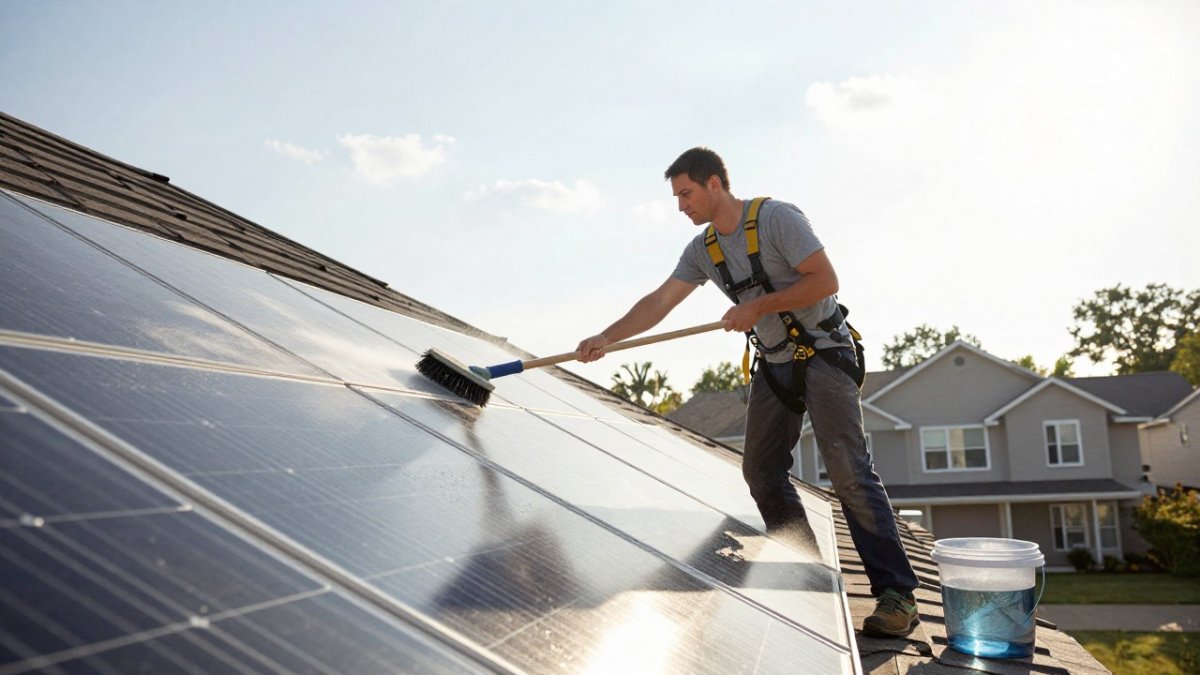
- DIY is reasonable for ground-mounted arrays, carports, and single-story low-slope roofs you can reach from a stable ladder, using deionized or filtered water and a soft brush.
- Hire a professional for steep or high roofs, tile and metal roofs that are easy to damage, arrays with heavy bird activity, and any system where the warranty language is strict.
- Get a quote either way, a written per-panel price tells you whether the professional premium is $50 or $250, and that number decides the comparison.
One more factor: reporting. A professional cleaning can include a before-and-after performance check, which DIY does not. If you want documented output data for a warranty claim or a solar lease, that reporting has value beyond the cleaning itself.
Commercial Solar Panel Cleaning Options
Commercial solar panel cleaning is often a procurement decision. A warehouse, school or ground-mount array has more panels, harder access and a budget owner who needs a defensible scope of work. Facilities managers typically compare three structures: per-visit pricing, an annual service contract, and a performance-based agreement tied to measured output.
Per-visit pricing. You pay for each cleaning, usually quoted per site after a walkthrough. This suits arrays that only need attention after pollen season, wildfire smoke or a construction project nearby. The trade-off is that scheduling is reactive, and you may wait during peak demand.
Annual service contracts. A fixed number of cleanings per year at a set price. The right interval depends on local debris load, tilt angle and rainfall.
Whichever structure you choose, the written scope should answer these questions:
- Access and safety. How will crews reach roof-mounted arrays, and does the provider carry liability insurance and workers' compensation? Ask for a site-specific safety plan covering fall protection and electrical lockout.
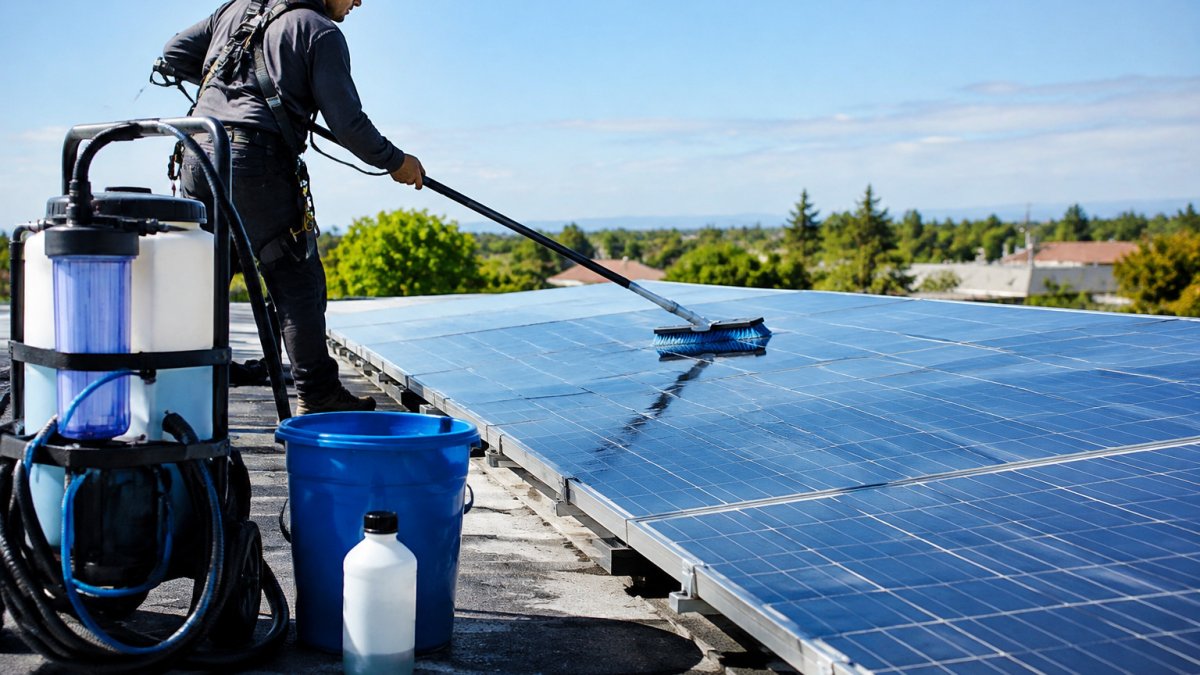
- Water source and method. Will they use deionized water, and where does it come from? On large sites, water hauling and runoff can be a real cost and compliance issue.
- Scheduling. What is the notice period, and how do they handle weather delays? For retail and logistics sites, cleaning during operating hours may be impossible.
- Reporting. What does the post-service report include, panel count, before-and-after output, photos, and any damaged modules noted?
- Exclusions. Are bird proofing, gutter clearing and electrical repairs in scope or quoted separately?
Ask any provider for performance data from comparable sites rather than accepting a generic ROI claim. Individual results vary with tilt, shading and local debris, so the only reliable comparison is your own baseline production data against post-cleaning readings.
For large solar farms, request a written maintenance plan covering schedule, water source, safety procedures and how output is measured. For a portfolio of sites, ask whether pricing scales per panel or per site, the answer often changes which vendor is cheapest at your volume.
Choosing Your Next Step: Booking a Cleaning Quote
Start by listing your system size, roof type and how dirty the panels get. Then request written quotes from two or three providers, using the same questions for each. Compare the per-panel rate, minimums, travel fees and what the report includes.
To get a quote from Mr Clean Solar Cleaning, visit the company website or call the team to book.
Frequently Asked Questions
How much does professional solar panel cleaning cost?
Pricing varies with system size, roof access and whether the job is residential or commercial. Commercial jobs are usually quoted per site. Mr Clean Solar Cleaning does not publish standard rates, so request a quote from its website to compare against the alternatives.
How often should solar panels be professionally cleaned?
Most owners schedule cleaning based on local dust, bird activity and seasonal rainfall rather than a fixed interval. In dry, dusty areas of Northern California, twice a year is a common starting point, while homes with little soiling may need less. Commercial sites with large arrays often choose a recurring service schedule. Track your monthly output after cleaning to decide whether the interval is worth it.
Is professional solar panel cleaning worth the cost?
It depends on how much output your soiling is costing you. Dust, bird droppings and mineral deposits can reduce production, and the gain from cleaning is largest on systems that are visibly dirty. Results vary by system and conditions. Compare the cleaning fee against the expected monthly gain, and ask any provider for before-and-after performance data before you commit.
Should I hire a professional or clean solar panels myself?
DIY cleaning suits homeowners with safe, easy roof access and a low-pressure hose or soft brush. Professional crews can bring insurance coverage and specialised cleaning methods. Check your panel warranty before cleaning, since some manufacturers limit cleaning methods, and avoid pressure washers, which can damage the glass.