 comparison
Solar Inverter Repair vs Replacement: Cost and Decision Guide
Last Updated: October 30, 2026
Quick Summary
Repair is usually the better choice when the fault is isolated, the unit is young, the warranty covers it, and the estimate sits well below replacement cost. Replacement makes more sense for recurring faults, aging units, discontinued parts, or long outages. Compare total lifecycle cost, including lost generation, before deciding on solar inverter repair or replacement.
- Lost generation during downtime often exceeds the repair invoice, so model both timelines.
- Ask technicians to split estimates into parts, labor, mobilization and expected downtime.
- Repairs usually suit units under about 8 years old with active warranty coverage.
- Recurring faults within 12 months point to replacement or a fleet-wide review.
- Get a written diagnosis and estimate before authorizing any work.
Table of Contents
- Why Inverter Failures Hit Solar Farm Output Harder Than You Think
- Common Inverter Faults, Warning Signs and Troubleshooting Steps
- Solar Inverter Repair Cost: What Fixes Typically Run
- Solar Inverter Replacement Cost and Lost-Generation Value
- Solar Inverter Lifespan, Age and Warranty Coverage
- A Repair-or-Replace Decision Framework for Fleet Operators
- Booking an Inverter Assessment Before Your Next Maintenance Cycle
- Frequently Asked Questions
Why Inverter Failures Hit Solar Farm Output Harder Than You Think
A failed inverter can take a whole block of a solar farm offline at once, which makes this one of the costliest single-component faults in utility-scale operations. Operators frequently underestimate the lost-generation cost of waiting on a repair. A solar inverter is the bridge between the panels' direct current and the grid's alternating current, so when it fails, the energy those panels produce goes nowhere.
The real question is rarely "can it be fixed?" It is "what does each day of downtime cost, and what does a repair or replacement cost by comparison?" Many operators find that lost output over a few weeks can exceed the price of a major repair. That is why the repair-versus-replacement decision deserves a structured look rather than a reflex reaction.
This guide compares the cost of repairing and replacing a solar inverter, shows how to troubleshoot faults before calling a technician, and offers a decision framework for fleet operators. Our aim is to give you a clear basis for choosing, not a blanket recommendation.
Common Inverter Faults, Warning Signs and Troubleshooting Steps
Most inverter problems announce themselves before they fail outright. Watch for error or fault codes on the display, unusual humming or clicking, overheating cabinets, and a drop in power output that does not match irradiance levels. Each of these deserves a diagnostic check.
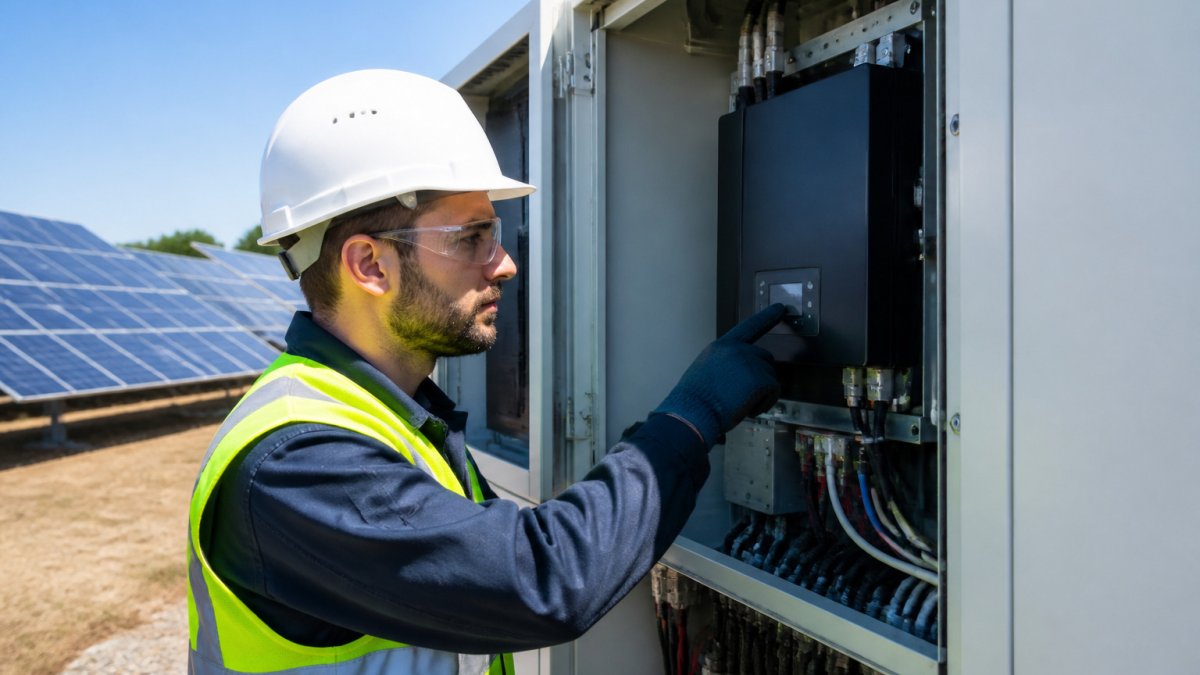
Start with the basics. Confirm the inverter has power, check that the DC disconnects and AC breakers are in the correct position, and review the monitoring system for the fault code and the time it first appeared. A recurring code points to a different cause than a one-time event.
Watch out: resetting an inverter repeatedly without finding the cause can mask a developing fault and push the failure into a more expensive window.
Document everything before a technician arrives. Record the fault code, the time, the output readings, and any environmental conditions. This shortens diagnosis and gives you a clear maintenance history for the repair-or-replace decision that follows.
Solar Inverter Repair Cost: What Fixes Typically Run
Repair cost is not one number. For a solar farm, it is the sum of parts, field labor, truck rolls, diagnostic time, and the generation you lose while the unit is down. Treating it as a single figure is the most common budgeting error we see.
Published guides give wide ranges because they mix equipment classes. One guide reports minor field repairs typically run $150 to $500 GreenLancer solar inverter repair guide, while another reports typical repair costs of $500 to $3,000 for a broader range of work Sungo Energy repair versus replacement cost comparison. Those figures are written largely for residential and small commercial units. A central inverter or a large three-phase string inverter on a solar farm sits at the top of or above those ranges once you add mobilization and crane or lift access where required.
What actually drives the repair invoice
- Parts. Fans, contactors, fuses, and surge-protection devices are commodity items with short lead times. Power modules, capacitors, control boards, and IGBT assemblies are proprietary, often stocked only by the manufacturer, and priced accordingly.
- Labor and skill level. A fan swap may be a one-technician, one-hour job. Component-level work on an energized-class cabinet requires qualified personnel, isolation, and often two people for safety.
- Mobilization. A truck roll to a remote array block has a fixed cost whether the fix takes one hour or six. Multiple trips for diagnosis, parts, and repair multiply that cost.
- Diagnostic time. Fault codes narrow the cause but rarely name it. Time spent tracing a recurring ground fault or grid-side issue is billable and can exceed the parts cost.
- Warranty administration. If the manufacturer covers the part but not the labor, you still pay the field cost and the downtime.
Minor field repairs versus component-level work
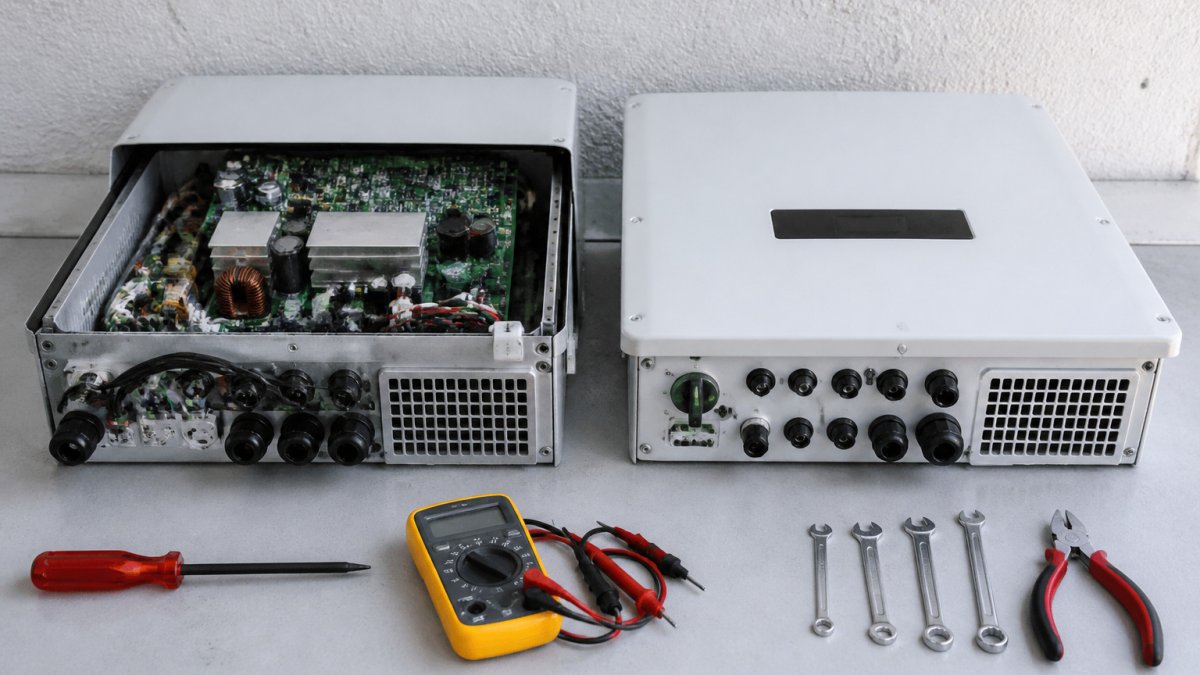
Minor field repairs, replacing a fan, reseating a connection, clearing a latched fault, replacing a fuse, are usually quick and inexpensive and can often be handled during a scheduled maintenance visit. Component-level work, replacing power modules, capacitors, or surge-damaged boards, costs more, takes longer, and depends on parts availability. Surge damage from lightning or grid events often falls in the second category and can change the economics quickly, especially if several units on the same feeder were hit.
Pricing depends on the specific unit, site conditions and scope of work. Confirm costs with a qualified technician who has reviewed your unit, and get the estimate in writing before authorizing work.
Solar Inverter Replacement Cost and Lost-Generation Value
Replacement costs are higher up front and easier to underestimate than repair costs, because the invoice is only part of the number. One guide reports replacement costs of $1,200 to $4,700 TerraSol Energies inverter replacement guide, while another puts professionally installed replacement at $1,000 to $5,000 Sungo Energy replacement cost estimates. Those ranges are typically written for residential-scale units. For a solar farm, add equipment sizing and procurement, crane or lift access, DC and AC re-termination, protection settings, and commissioning.
The full replacement cost stack
A replacement decision should account for:
- Equipment. A like-for-like unit versus a larger or newer model with different dimensions, weight, and clearance requirements.
- Installation labor and access. Central inverters and large string inverters often need lifting equipment and a multi-person crew.
- Balance-of-system changes. Cabling, disconnects, fuses, and monitoring hardware may need to change if the replacement model differs.
- Interconnection and commissioning. Replacement equipment frequently requires updated protection settings, utility notification or approval, and recommissioning tests before it can export. These steps add calendar time, not just cost.
- Disposal and recycling. Failed inverters contain electronics and should go through responsible e-waste handling rather than scrap.
- Lost generation during the outage. This is usually the largest line item and the one most often left out of the budget.
Lost-generation math you can actually use
Lost value equals (daily kWh lost) × (price per kWh) × (days offline). The inputs matter more than the formula:
- Daily kWh lost is the expected output of the affected block, adjusted for season and irradiance, not the inverter's nameplate rating.
- Price per kWh should reflect your actual revenue or avoided cost, including any time-of-use or capacity value.
- Days offline should include procurement and scheduling lead time, not just the repair or swap itself. A part with a six-week lead time keeps the block down for six weeks even if the install takes one day.
Run the model twice, once on the repair timeline and once on the replacement timeline, and compare total cost, not sticker price. A repair that saves $2,000 on parts but adds three weeks of downtime can lose more than it saves.
Fleet-level prioritization
On a multi-inverter site, you rarely face one decision, you face a queue. Rank faults by capacity affected, recurrence within the past 12 months, parts lead time, and production impact per day. A low-capacity unit with a cheap fix can wait behind a high-capacity unit with a long lead time, even if the second repair costs more. Track failures by model and component; clusters of the same fault point to a systemic issue that justifies a fleet-wide review rather than unit-by-unit fixes.
Solar Inverter Lifespan, Age and Warranty Coverage
Inverter lifespan is shorter than panel lifespan. One source notes that string inverters often last 10 to 15 years and may need replacement at least once over a system's life TerraSol Energies lifespan guidance. Age matters because failure rates tend to rise as components wear.
Warranty coverage often decides the question before cost does. Repairs are generally more attractive on newer, warrantied equipment, since the manufacturer may cover parts or labor Sungo Energy warranty considerations. Check your warranty terms, including what voids coverage and how long claims take to process, before authorizing work.
A Repair-or-Replace Decision Framework for Fleet Operators
For a fleet, decide unit by unit using a simple scoring approach:
| Factor | Favors Repair | Favors Replacement |
|---|---|---|
| Unit age | Under 8 years | Near or past expected lifespan |
| Warranty | Active and covers the fault | Expired or excludes the fault |
| Fault history | First-time, isolated fault | Recurring faults in 12 months |
| Repair estimate | Well under replacement cost | Approaches replacement cost |
| Parts availability | Parts readily available | Parts discontinued or long lead time |
| Lost-generation impact | Short outage acceptable | Extended outage is costly |
Score each unit against these factors. If repair wins on most rows and the estimate is well below replacement cost, repair is usually the better choice. If several rows favor replacement, plan for replacement and use the lost-generation model to set the timeline.
Track failure patterns across the fleet as well. Several failures of the same model or component suggest a systemic problem that justifies a broader review, not just unit-by-unit fixes.
Booking an Inverter Assessment Before Your Next Maintenance Cycle
Schedule an inverter assessment before your next maintenance window rather than after a failure. A pre-maintenance check catches developing faults, confirms warranty status, and gives you a repair estimate while you still have options.
When you request an assessment, ask for a written diagnosis, a repair estimate, a replacement comparison, and an estimate of expected output recovery. For pricing on Mr Clean Solar Cleaning's services, contact us directly for a quote, since we do not publish fixed rates for this work.
Frequently Asked Questions
How do you decide whether to repair or replace a solar farm inverter?
Start with the repair quote, then compare it against the inverter's age, remaining warranty, parts availability and how often it has failed. If a repair is inexpensive and the unit is relatively young and under warranty, repair usually makes sense. If repair costs approach a large share of replacement cost, the unit is old, or faults keep recurring, replacement often gives better long-term value. Factor in lost generation during downtime, since a fault that idles an inverter can cost more in output than the repair itself.
What are the signs that a solar inverter needs repair?
Common signs include error or fault codes on the monitoring system, output that drops below what irradiance levels would predict, frequent restarts or grid disconnections, unusual noise or burning smells, and error alerts from the monitoring platform. Compare each inverter's output against its neighbors on the same string or block, since a single unit underperforming while others run normally usually points to an inverter problem rather than the panels.
How much does it cost to repair or replace a commercial solar inverter?
Published estimates vary widely. Costs vary with inverter size, parts availability and site conditions, and general published ranges may not reflect utility-scale equipment. Request an itemized repair quote and a replacement quote for your specific model before deciding, because pricing depends on inverter size, parts availability and site conditions.
How long does a utility-scale solar inverter typically last?
Inverters may need replacement at least once during a solar system's life. Central inverters used at utility scale may differ, so confirm expected service life with the manufacturer. Age matters most when combined with warranty status and fault history, since an older unit with recurring faults is a stronger replacement candidate than an older unit that has run reliably.