 blog
Is Solar Panel Cleaning Covered by Insurance?
Quick Summary
In most cases, a standard homeowners policy does not pay for solar panel cleaning itself, because cleaning is treated as routine maintenance. If a cleaner damages your panels or roof, the cleaning company's general liability insurance usually responds instead, and storm or falling-debris damage may be covered under your own policy.
- Routine cleaning is treated as maintenance, which most homeowners policies exclude.
- Damage a cleaner causes is usually a liability question, covered by the cleaning company's insurance.
- Storm, fire, or falling debris damage may be covered under your own policy, depending on its terms.
- Ask for a certificate of insurance and confirm general liability limits before booking.
- Ask in writing whether rooftop work, work at height, or solar panel cleaning is excluded.
Table of Contents
- Does Homeowners Insurance Cover Solar Panel Cleaning Work?
- Homeowners Insurance for Solar Panels: What Your Policy Actually Covers
- Who Pays When a Cleaner Damages Your Panels or Roof
- Contractor Liability Insurance: What a Cleaning Company Should Carry
- How to Verify Coverage Before Hiring a Solar Cleaner
- Solar Panel Cleaning Cost and Whether Cleaning Pays Off
- Booking Your Next Solar Cleaning With Mr Clean Solar Cleaning
- Frequently Asked Questions
Does Homeowners Insurance Cover Solar Panel Cleaning Work?
Last Updated: November 7, 2026
Is solar panel cleaning covered by insurance? In most cases, a standard homeowners policy does not pay for the cleaning service itself. Cleaning is a maintenance expense, and most policies cover sudden, accidental losses instead. The bigger question is what happens if something goes wrong during the job.
Homeowners often ask this question, especially after hearing stories about pressure washing damaging panels, and wonder who pays if it happens to them. This guide explains how coverage works, who is responsible for what, and how to protect yourself before you book.
Short answer: A homeowners policy generally does not cover the cost of routine cleaning. It may cover damage to your property caused by a covered event, but it does not automatically cover damage done by a hired contractor.
- Routine cleaning is treated as maintenance, which most policies exclude.
- Damage caused by a cleaner is a liability question, and that usually falls under the cleaning company's insurance.
- Storm, fire, or falling debris damage may be covered under your own policy, depending on its terms.
Read your policy wording carefully. Coverage varies by insurer, state, and policy type.
Homeowners Insurance for Solar Panels: What Your Policy Actually Covers
Your homeowners policy may include some protection for solar equipment, but usually not for every type of loss. Many policies cover solar panels as part of the dwelling, while others treat them as an add-on.
Here is what to check:
- Covered perils: Storms, hail, fire, lightning, and falling trees often qualify.
- Exclusions: Wear, dirt buildup, and gradual performance loss are commonly excluded.
- Coverage limits: Some policies cap the amount paid for solar equipment.
- Deductibles: A deductible may be higher than the repair cost for small damage.
Watch out: Dirt and bird droppings reduce output over time. Insurers generally treat this as normal wear, not a covered loss.
Who Pays When a Cleaner Damages Your Panels or Roof
The single most useful distinction in this whole topic is whose policy responds. Your homeowners policy and the cleaning company's liability policy are two separate contracts, and they cover different things. Most people conflate them, which is why the question feels unanswerable.
Here is the plain-language rule: your homeowners policy responds to sudden, accidental losses to your property from covered perils. The cleaning company's general liability policy responds to damage the company causes while performing the work. When both could apply, your insurer may pay you first and then pursue the contractor's insurer to recover what it paid. That recovery process is called subrogation, and it is why documentation matters so much.
Use this matrix to see which policy is likely to respond to each type of incident:
| Incident | Who is responsible | Policy most likely to respond | What to do first |
|---|---|---|---|
| Cleaner cracks a panel with a pole, brush, or hose | Cleaning company | Contractor general liability | Photograph the panel, note the time, notify the company in writing |
| Cleaner's ladder or foot traffic damages shingles or flashing | Cleaning company | Contractor general liability (and possibly the roofer's workmanship warranty) | Photograph the roof area, get a roofing estimate |
| A crew member falls and is injured on your roof | Cleaning company | Contractor workers' compensation; your homeowners liability may also be drawn in | Do not admit fault; document the incident and call your agent |
| Water intrusion from cleaning gets behind panels and damages wiring | Cleaning company, if caused by their method | Contractor general liability; your homeowners policy may cover the resulting interior damage | Stop the work, photograph the intrusion, get an electrician's assessment |
| Storm, hail, or falling limb damages panels after a cleaning visit | No one, the cleaner did not cause it | Your homeowners policy, subject to your deductible | File a claim with your own insurer |
| Gradual output loss from dirt, pollen, or bird droppings | No one, this is maintenance | Typically not covered by either policy | Schedule cleaning; do not file a claim |
| A pre-existing defect or failed microinverter surfaces during cleaning | Depends on whether the cleaner's method caused or merely revealed it | Often disputed; contractor liability if the cleaner caused it, manufacturer warranty if not | Get a written assessment from a solar technician |
A few mechanics are worth understanding because they decide outcomes:
- Negligence is the trigger for the contractor's policy. General liability responds when the company's work causes bodily injury or property damage to a third party. If the cleaner did nothing wrong and a panel failed on its own, the contractor's policy generally will not pay.
- Your deductible can swallow small claims. If a cracked panel costs less to replace than your homeowners deductible, filing a claim may cost you more than paying out of pocket. Ask the cleaner to cover it through their liability policy first.
- Filing a homeowners claim has a record. Even a paid claim can affect your premium or renewal. Reserve your own policy for losses that clearly exceed your deductible and clearly stem from a covered peril.
- Workers' compensation is not your policy. If a crew member is injured on your property, the company's workers' compensation should be the primary source. Your homeowners liability coverage could still be drawn in, which is another reason to confirm the cleaner carries both.
Watch out: if you let the cleaner pay for a repair directly without documenting the damage first, you may weaken your own claim if the repair turns out to be inadequate or if the company later disputes responsibility. Photograph everything before any repair begins.
Keep dated before-and-after photos of every visit, save the company's written confirmation that they carry liability coverage, and put any damage report in writing the same day. Those three habits make the difference between a clean claim and a disputed one.
Contractor Liability Insurance: What a Cleaning Company Should Carry
A professional cleaning company should carry general liability insurance and, if it employs workers, workers' compensation. General liability covers property damage and injuries to third parties caused by the company's work. Workers' compensation covers injuries to the cleaning crew.
Ask any cleaner for a certificate of insurance. It shows the coverage types and limits. Mr Clean Solar Cleaning is fully insured, and its team is OSHA-trained.
- General liability for property damage to your home
- Workers' compensation for crew injuries on your roof
- Coverage limits that match your property's value
How to Verify Coverage Before Hiring a Solar Cleaner
Most homeowners ask whether the cleaner is insured and accept a yes. That is not verification. Verification means reading a document and confirming three things: the coverage types, the dollar limits, and whether the specific work on your roof is included.
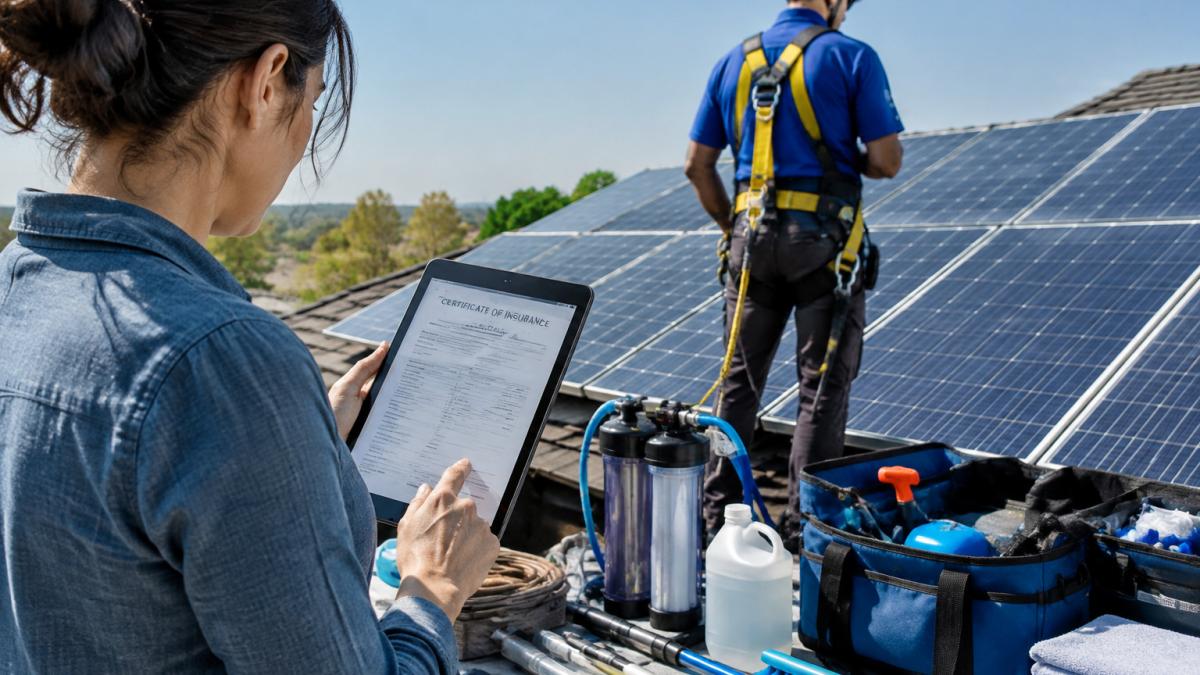
Step 1: Request a certificate of insurance, not a verbal assurance. The certificate of insurance (often called a COI) is a one-page summary issued by the cleaner's insurer or broker. It lists the insured's legal name, the policy types, the policy numbers, the effective and expiration dates, and the limits.
Step 2: Confirm the insured name matches the company you are hiring. A common problem is a certificate issued to a different legal entity, a franchise, or an individual owner rather than the business performing the work. If the names do not match, ask why in writing.
Step 3: Check that general liability is present and read the limit. General liability is the coverage that responds to property damage the cleaner causes to your panels or roof. Look at the per-occurrence limit and the general aggregate limit.
Step 4: Confirm workers' compensation if the company uses employees. If a crew member is injured on your roof, workers' compensation is the coverage that should respond first.
Step 5: Ask about endorsements and exclusions for work at height and solar work. This is the step almost everyone skips. A general liability policy can carry exclusions for roofing work, work above a certain height, or work on energized equipment.
Step 6: Ask how a claim would be handled. Find out who to contact, whether the company reports incidents to its insurer promptly, and whether it will provide a written incident report. A company that has a process will answer quickly.
A short checklist you can send by email:
- Current certificate of insurance with effective and expiration dates.
- General liability per-occurrence and aggregate limits.
- Workers' compensation coverage, or confirmation that subcontractors carry their own.
- Written confirmation that rooftop, work-at-height, and solar panel cleaning are not excluded.
- The name and contact for claims or incident reporting.
- Confirmation of the cleaning method, deionized water and soft brushes are lower risk than pressure washing, and some manufacturers specify methods in their warranty terms.
Watch out: a certificate of insurance is a snapshot, not a guarantee. It shows coverage on the date it was issued. If the policy expires before your scheduled cleaning, ask for an updated certificate dated within the coverage period of your job.
One more point on warranties: cleaning itself generally does not void a solar warranty, but the method can matter. Pressure washing at high settings can force water past seals and is discouraged by many manufacturers. Ask the cleaner which method they use and whether it follows the panel manufacturer's guidance.
Solar Panel Cleaning Cost and Whether Cleaning Pays Off
Solar panel cleaning cost depends on system size, roof access, and how dirty the panels are. Pricing depends on your specific setup, so request a quote for current prices.
Whether cleaning pays off depends on how much output you lose to dirt. Many homeowners see only a small bump in their energy bill, while others with heavy bird droppings or dust see a larger gain. Cleaning is most worthwhile when buildup is visibly heavy and your system is producing noticeably less than expected.
One homeowner reported that their energy bill dropped by $45 per month after cleaning. Another commercial client with a 200-panel warehouse system reported a 28% ROI improvement. Results vary, so use the numbers from your own system to decide.
Booking Your Next Solar Cleaning With Mr Clean Solar Cleaning
If you want to verify coverage, see before-and-after results, or get a quote for your system, Mr Clean Solar Cleaning is ready to help. We are fully insured, OSHA-trained, and provide detailed performance reports after every visit. Book your next cleaning with Mr Clean Solar Cleaning and protect your investment with a clean, professional service.
Frequently Asked Questions
Does homeowners insurance cover solar panel cleaning?
Usually not as a routine service. Homeowners policies generally cover sudden, accidental damage to your home, but routine maintenance such as cleaning is typically excluded. If a cleaner damages your panels or roof, the claim usually goes to the cleaning company's general liability policy, not yours. Check your policy wording for exclusions, and ask your cleaner for a certificate of insurance before work begins so you know who would pay if something goes wrong.
Will insurance cover solar panels damaged during cleaning?
It depends on who caused the damage and which policy applies. If a contractor's careless work breaks a panel, the contractor's commercial general liability policy is the usual route for a claim. Your homeowners policy may respond if the damage is sudden and accidental and not excluded, but insurers often deny claims tied to maintenance work. Document the damage with photos and keep the cleaner's invoice and insurance information.
Does homeowners insurance cover solar panels damaged by a storm?
Often yes, when the policy includes dwelling coverage and the storm damage is a covered peril such as wind or hail. Solar panels attached to the home are usually treated as part of the dwelling. Review your deductible and any wind or hail exclusions, since deductibles can be a percentage of the home's insured value and may make smaller claims uneconomical.
How much does solar panel cleaning cost?
Pricing depends on system size, roof access, panel count, and how dirty the panels are. Pricing depends on your specific property, so request a quote for current prices. Visit the Mr Clean Solar Cleaning website to request current pricing, and ask whether the quote includes a performance report and proof of insurance.