 ultimate-guide
Do Dirty Solar Panels Affect Efficiency?
Table of Contents
- How Dirty Solar Panels Reduce Energy Output
- What Causes Solar Panel Soiling and Performance Degradation
- Quantifying Efficiency Loss: Real Numbers
- Solar Panel Cleaning Frequency and System Maintenance
- How to Clean Solar Panels Safely Without Voiding Warranty
- Cost-Benefit Analysis: When Cleaning Improves ROI
- Technology Solutions: Panel Tilt and Self-Cleaning Systems
- Frequently Asked Questions
Last Updated: September 20, 2026
How Dirty Solar Panels Reduce Energy Output
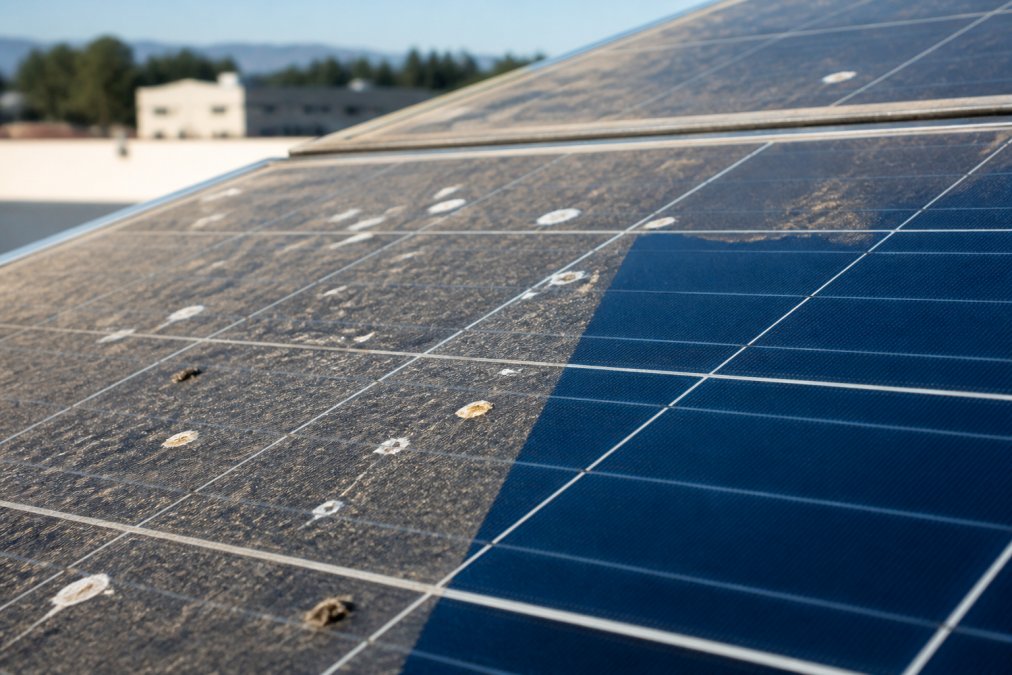
When dust, grime, bird droppings, and other contaminants accumulate on photovoltaic cells, they block sunlight and reduce energy conversion, resulting in lower output and higher electricity bills, a problem known as dirty solar panels efficiency loss.
Efficiency loss depends on climate, dust patterns, rainfall frequency, and panel tilt angle. In dry climates with minimal rain, even thin dust reduces yield, while thick buildup from bird droppings or pollution can cut output substantially.
Panels receiving regular maintenance maintain peak efficiency, while neglected systems degrade progressively. Understanding soiling accumulation helps you decide whether professional cleaning is worth the investment.
What Causes Solar Panel Soiling and Performance Degradation
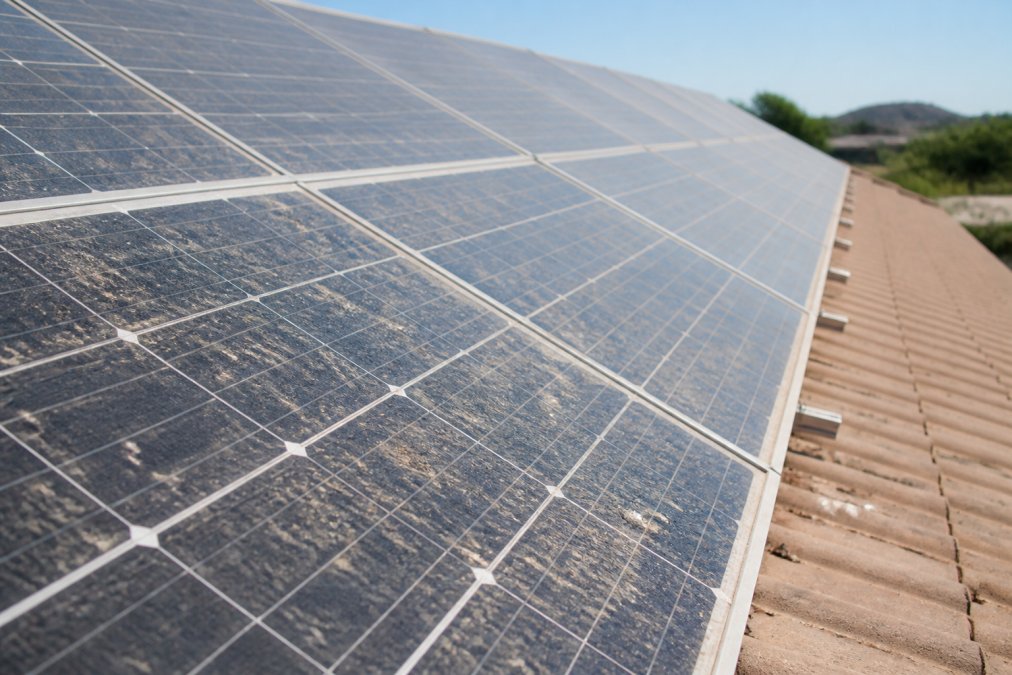
Solar panel soiling refers to the accumulation of particles, deposits, and contaminants on the glass surface that reduce light transmission and energy production. Performance degradation follows from this buildup, as the photovoltaic cells receive less irradiation and therefore generate less electrical current.
Dust, Pollen, and Atmospheric Pollution
Dust settles naturally through wind and air movement. Fine particulate matter from roads, construction sites, and industrial facilities accumulates faster in polluted areas. Pollen adds another layer, especially in spring and fall. In urban and industrial zones, dust and pollution combine to block sunlight more effectively than dust alone.
Accumulation rates vary by location: desert regions experience faster buildup from dry winds, urban areas from vehicle emissions, and agricultural regions from pollen. Understanding your local environment helps predict cleaning frequency.
Impact of Bird Droppings on Solar Efficiency
Bird droppings are among the most damaging soiling forms. Unlike dust, they create concentrated deposits that block sunlight in specific areas. Multiple droppings accumulate to substantially reduce efficiency.
The problem intensifies near water, in agricultural regions, and urban centers. Droppings accelerate glass degradation through acidic etching, making prompt removal critical for large arrays.
Environmental Factors: Dry Winds and Particulate Matter
Dry winds accelerate dust accumulation and prevent natural rain-wash cleaning. Regions with extended dry seasons experience faster soiling. Particulate matter from wildfires, dust storms, and industrial sources creates thicker, stubborn buildup.
Humidity and temperature influence soiling patterns: humid climates cause dust to stick more readily, while temperature extremes bond dust more firmly. These factors explain regional cleaning frequency differences.
Quantifying Efficiency Loss: Real Numbers
Understanding dirty solar panels efficiency requires examining how soiling severity, climate, and environmental conditions affect output, research provides measurable ranges rather than guesses.
Typical Efficiency Loss by Soiling Level
Light dust reduces output by 2-5%. Moderate soiling (visible dust film, pollen, scattered droppings) cuts production by 5-15%. Heavy soiling (thick dust, multiple droppings, salt spray) reduces output by 15-25% or more. Extreme cases exceed 30%.
The National Renewable Energy Laboratory (NREL) has documented soiling losses across multiple climates. In arid and semi-arid regions, monthly soiling losses average 4-5% without cleaning. In humid climates with regular rainfall, losses drop to 1-3% monthly because rain provides natural cleaning. Coastal areas experience accelerated soiling from salt spray, with losses reaching 6-8% monthly if not addressed.
How to Estimate Your Specific Loss
Start with your system's rated capacity and recent production data. If your 6 kW system normally produces 25 kWh daily but dropped to 21 kWh, you're experiencing 16% loss. At your local electricity rate, that's roughly $17 per month in lost value.
Use monitoring apps and inverter data to track output. Compare current production to the same month last year, accounting for seasonal differences. A sudden drop in stable weather signals soiling.
Regional Breakdown: Where Soiling Hits Hardest
Arid and Semi-Arid Regions (Southwest, Great Plains): Dust storms, minimal rainfall, and dry winds create the fastest accumulation. Systems here typically lose 4-6% monthly without cleaning. Quarterly cleaning is often necessary to maintain peak efficiency.
Humid Subtropical Regions (Southeast): High pollen counts, frequent bird activity, and occasional dust create moderate soiling. Monthly losses average 2-4%. Rain provides partial cleaning, but bird droppings and sticky pollen residue require semi-annual professional cleaning.
Coastal Areas (California coast, Atlantic seaboard): Salt spray accelerates soiling and glass degradation. Monthly losses can reach 5-8%. Professional cleaning every 3-4 months is common to prevent long-term panel damage.
Agricultural Regions (Midwest, Central Valley): Dust from field operations, pollen, and occasional pesticide residue create variable soiling. Monthly losses range from 3-5%. Cleaning frequency depends on proximity to active fields and seasonal patterns.
Temperate Regions with Regular Rainfall (Pacific Northwest, Northeast): Rain provides significant natural cleaning. Monthly losses typically stay below 2-3%.
The Compounding Effect Over Time
Soiling loss compounds over time. Without cleaning in high-soiling climates, cumulative losses can exceed 30-40% annually. Early intervention prevents exponential degradation.
Solar Panel Cleaning Frequency and System Maintenance
Cleaning frequency depends on climate, environment, and energy goals. Regular rainfall provides natural cleaning; dry climates or heavy dust/bird/pollen activity require more frequent cleaning.
How to Clean Solar Panels Safely Without Voiding Warranty
Cleaning your own panels carries real risks. Most solar panel warranties cover defects in materials and workmanship, but they exclude damage caused by improper maintenance. This means DIY cleaning mistakes can void warranty protection, a costly consequence.
Why DIY Cleaning Creates Micro-Cracks and Safety Risks
Pressure washing is the most common mistake. High-pressure water can force moisture behind the panel frame, damaging electrical components and seals. Even soft-bristle brushes used too aggressively can create micro-cracks in the glass that expand over time, reducing panel lifespan and efficiency. These cracks often aren't visible immediately but degrade performance gradually.
Professional Cleaning vs. Rain-Wash Effect
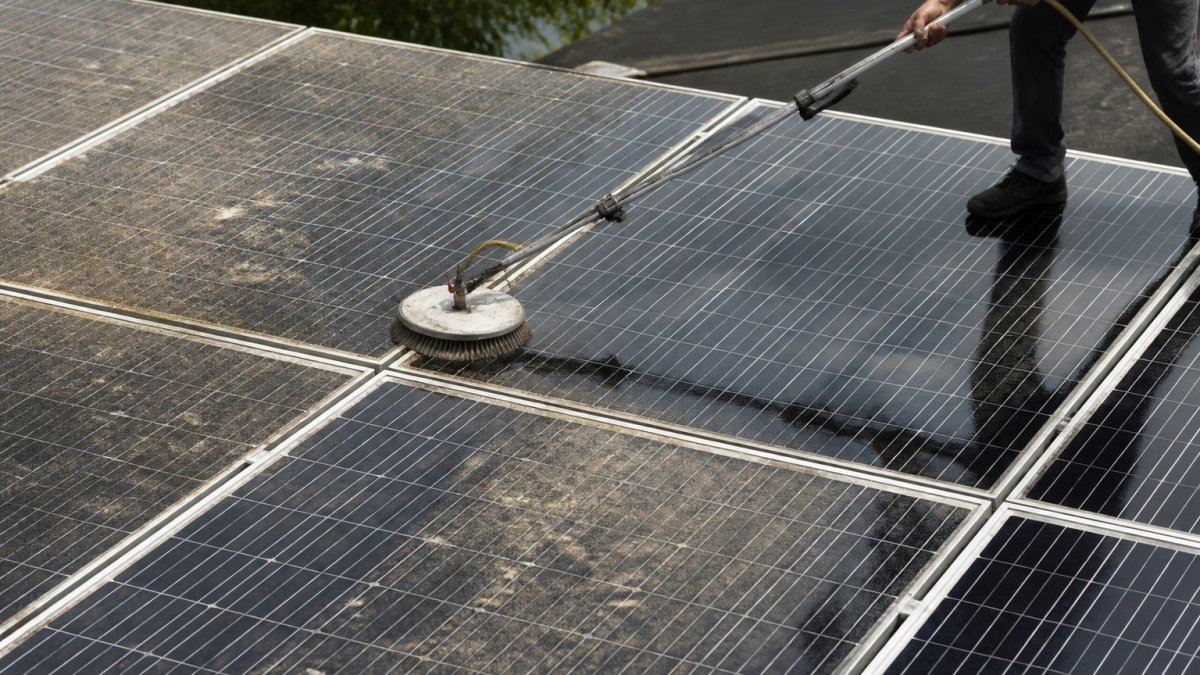
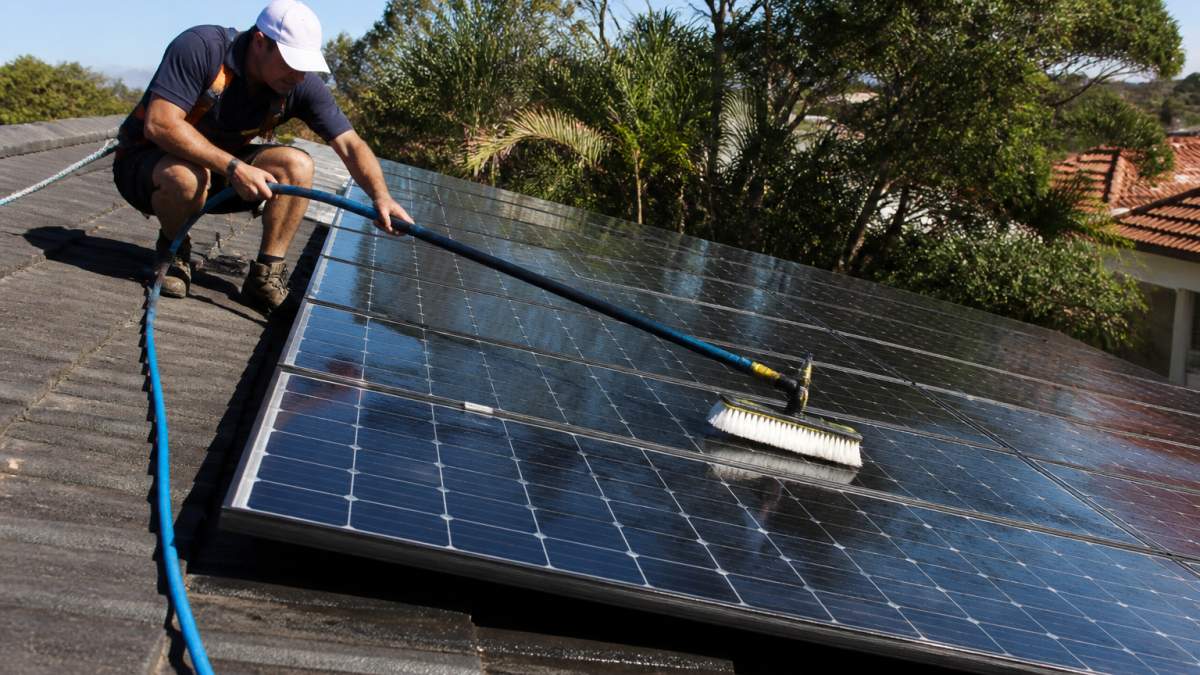
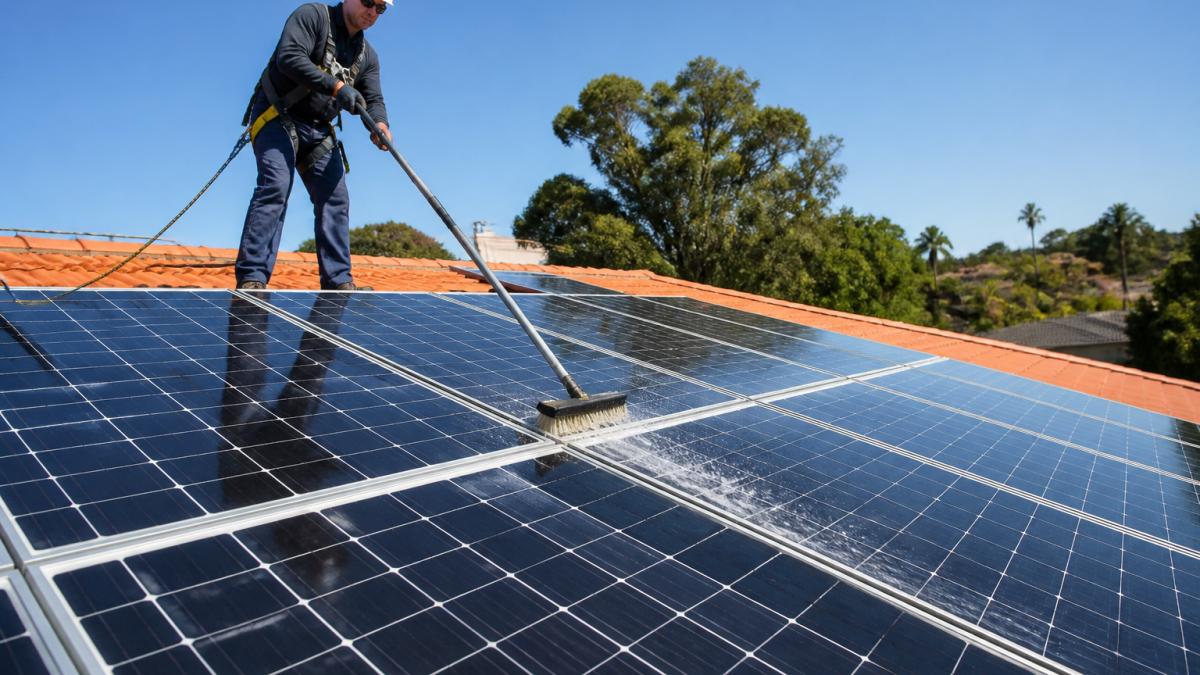
Professional cleaning uses deionized water and specialized soft-bristle systems engineered specifically for solar glass. This approach removes stubborn buildup without risk of damage. Deionized water leaves no mineral residue or streaks, maximizing light transmission.
Cost-Benefit Analysis: When Cleaning Improves ROI
Deciding whether to invest in professional cleaning requires comparing the cost of service against the energy value you'll recover. This section provides a framework to calculate ROI for your specific system and climate.
The ROI Calculation Framework
Start with three numbers:
- Estimated efficiency loss (from the section above, or your monitoring data)
- Professional cleaning cost (typically $150-$400 for residential systems, depending on size and accessibility)
- Your local electricity rate (check your utility bill; average is $0.12-$0.16 per kWh)
Formula: (Daily kWh loss × Electricity rate × Days until next cleaning) ÷ Cleaning cost = ROI payback period in days.
Regional ROI Scenarios
High-Soiling Climates (Arid Southwest, Coastal Areas)
- Typical monthly loss: 4-6% of capacity
- Cleaning cost: pricing depends on quantity, dates, and delivery
- Payback period: 2-4 months per cleaning
- Recommendation: Quarterly cleaning (4 times yearly) is financially justified. Annual cleaning cost is offset by 15-25% annual efficiency recovery.
Moderate-Soiling Climates (Southeast, Midwest, Agricultural Areas)
- Typical monthly loss: 2-4% of capacity
- Cleaning cost: pricing depends on quantity, dates, and delivery
- Payback period: 4-8 months per cleaning
- Recommendation: Semi-annual cleaning (2 times yearly) typically breaks even. Some homeowners find annual cleaning sufficient if rain provides partial natural cleaning between professional services.
Low-Soiling Climates (Pacific Northwest, Northeast with Regular Rain)
- Typical monthly loss: 1-2% of capacity
- Cleaning cost: pricing depends on quantity, dates, and delivery
- Payback period: 8-12+ months per cleaning
- Recommendation: Annual or as-needed cleaning. Monitor production closely; clean only when you observe a measurable drop (5%+ loss) rather than on a fixed schedule.
System Size Matters
Larger systems justify more frequent cleaning because the absolute energy loss is greater. A 10 kW system losing 4% produces 400 Wh less per day than a 6 kW system with the same loss percentage. Over a year, that's roughly 146 kWh, worth $18-$23 at typical rates for your area.
Hidden Costs of Neglect
Delaying cleaning doesn't just reduce short-term energy production, it can increase long-term damage. Bird droppings left for months etch glass surfaces, reducing light transmission even after removal. Dust mixed with moisture can corrode electrical connections. Micro-cracks from DIY pressure washing or aggressive brushing expand over years, permanently reducing panel lifespan.
When to Skip Professional Cleaning
Professional cleaning is not always necessary. Skip it if:
- Your system is in a low-soiling climate with regular rainfall and you're monitoring production closely
- You've observed no measurable drop in output over the past 3-6 months
- Your system is small (under 4 kW) and efficiency loss is under 5%
- You're willing to wait for the next significant rain event to provide natural cleaning
In these cases, annual or as-needed cleaning (triggered by observed output drops) is more cost-effective than routine service.
Technology Solutions: Panel Tilt and Self-Cleaning Systems
Panel tilt angle influences how effectively rain cleans your system naturally. Steeper angles shed water and debris more readily, reducing soiling accumulation. Flatter installations collect more dust and require more frequent manual cleaning. If you're designing a new system, tilt angle selection affects long-term maintenance needs.
Frequently Asked Questions
How much efficiency do dirty solar panels lose?
Dirty solar panels typically lose between 15-25% of their energy output, depending on the severity of soiling and local environmental conditions. Heavy accumulation from bird droppings, dust, and atmospheric pollution can reduce energy yield even more. The exact impact depends on panel tilt angle, climate, and how long grime has accumulated on the photovoltaic cells.
How often should solar panels be cleaned to maintain optimal output?
Most systems benefit from professional cleaning 2-4 times per year, though frequency depends on your environment. Dry, dusty climates or areas with heavy bird activity may require quarterly cleaning. Regions with regular rainfall may need cleaning only twice yearly. Monitoring your energy output through inverter monitoring or energy monitoring apps helps identify when cleaning becomes necessary based on performance degradation.
Can bird droppings cause permanent damage to solar panels?
Bird droppings don't permanently damage the photovoltaic cells themselves, but they create localized hot spots that can degrade performance and, over time, cause micro-cracks in the glass or internal components. This is why prompt removal matters. Professional cleaning with deionized water prevents the acidic buildup that accelerates degradation and protects your warranty.
Does rain effectively clean solar panels, or do I need professional service?
Light rain provides some benefit through the rain-wash effect, but it's insufficient for heavy soiling. Rain cannot remove sticky bird droppings or fine particulate matter that bonds to the panel surface. Professional cleaning services use deionized water and soft-bristle systems that remove all contaminants without abrasive materials that cause micro-cracks, ensuring your system operates at peak efficiency and your warranty remains intact.