 ultimate-guide
How Often Should Solar Panels Be Cleaned? A 2026 Guide
Table of Contents
- Why Cleaning Frequency Matters for Your Photovoltaic System
- Signs Solar Panels Need Cleaning: Don't Ignore These Red Flags
- How Often Should Solar Panels Be Cleaned? Climate-Specific Schedules
- Solar Panel Cleaning Cost: What Affects Your Investment
- Best Tools for Cleaning Solar Panels: DIY vs. Professional
- ROI Analysis: Is Professional Solar Panel Cleaning Worth It?
- Micro-Inverter vs. String Inverter: How Configuration Affects Cleaning Impact
- Water Quality and Mineral Buildup: Why Deionized Water Matters
- Frequently Asked Questions
Last Updated: September 15, 2026
Why Cleaning Frequency Matters for Your Photovoltaic System
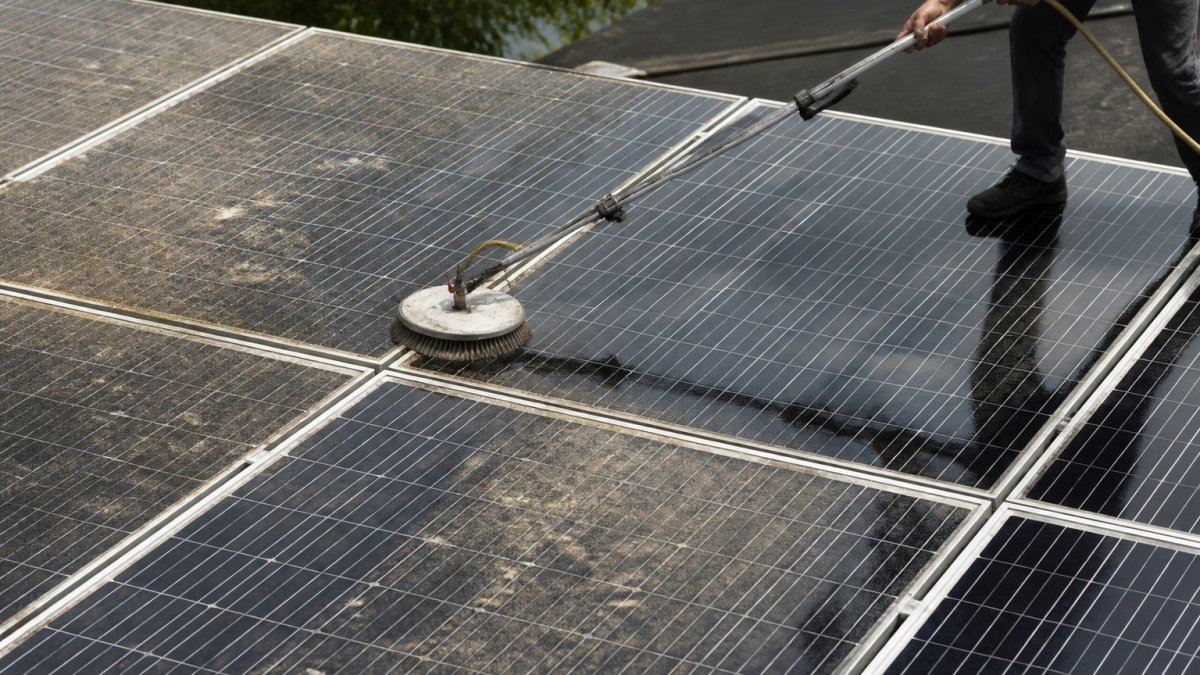
Dirty solar panels quietly drain your energy bill every month. Dust, pollen, and bird droppings block sunlight before it reaches the photovoltaic cells, and that soiling loss shows up directly in your system output. At Mr Clean Solar Cleaning, we've observed that homeowners sometimes assume their panels "self-clean" with rain, only to find their energy yield had been slipping.
Most advice says "clean every six months," but that number is close to useless. Cleaning frequency depends on where you live, what's falling on your roof, and how your system is wired. Get it wrong and you either waste money or leave real savings on the table.
Below, we break down the signs, climate-specific schedules, true cost, and ROI math so you can decide with numbers instead of guesswork.
Signs Solar Panels Need Cleaning: Don't Ignore These Red Flags
The clearest sign your panels need cleaning is a drop in energy production that doesn't match the weather. If it's a clear, sunny week and output is lower than the same week last month, debris is the likely culprit.
Visible Debris and Performance Drops
Walk outside and look at the glass. You don't need a ladder to spot trouble.
- Bird droppings create hot spots that block entire cell sections, not just the spot itself
- Pollen buildup leaves a fine yellow film that's easy to miss but cuts light transmission
- Atmospheric dust after a dry spell coats the whole array evenly
- Leaves and twigs collect along the bottom edge of tilted panels
What most guides miss: a single bird dropping affects more than its own footprint. Shading one cell in a series string drags down the whole string's output.
Monitoring Inverter Performance and Energy Yield
Your inverter is the best diagnostic tool you already own. Compare this month's kilowatt-hour production against the same month last year, adjusting for weather. A steady decline points to soiling; a sudden cliff points to equipment. Without monitoring, a professional inspection with a performance report gives you the baseline you're missing.
How Often Should Solar Panels Be Cleaned? Climate-Specific Schedules
Most homes need solar panel cleaning once or twice a year, but the honest answer depends on your local climate. A wooded lot with heavy pollen and bird traffic needs more attention than an open field with occasional dust. The table below is a starting point, use the climate-zone calendar underneath it to build a schedule that matches your roof.
Regional Climate Factors: Dust, Pollen, and Weather
| Climate Condition | Cleaning Frequency | Main Culprit |
|---|---|---|
| Heavy pollen season | Every 3-4 months | Pollen buildup |
| Dry, dusty summers | Every 4-6 months | Atmospheric dust |
| Wooded or rural lot | Every 3-4 months | Bird droppings, leaves |
| Coastal marine layer | Every 6 months | Salt residue |
| Regular rain, open field | Annually | Light soiling |
Rain helps, but it isn't a cleaning service. Light rain actually makes things worse by baking dust into hard water stains. A heavy downpour clears some debris, which is why many homeowners in wetter regions genuinely can clean once a year.
A Climate-Zone Cleaning Calendar (The Angle Most Guides Skip)
Generic "every six months" advice ignores that soiling rate depends on three variables: how much debris lands on the glass, how often rain rinses it off, and how much tilt helps it slide. Build your calendar around those three, not the wall calendar.
Arid and desert zones (low rain, high dust). Dust accumulates continuously and rain rarely rinses it. Expect a cleaning every 3-4 months, plus an extra pass after any dust storm or wildfire smoke event. Arrays under 15 degrees hold dust longer, so add a visit if your roof is shallow.
Humid coastal zones (salt, marine layer, frequent light rain). Salt residue bonds to glass and light rain smears it rather than clearing it. A 6-month cadence is typical, but move to every 4 months within a few miles of the shoreline. Salt also accelerates frame corrosion, so pair cleanings with a visual inspection of the mounting hardware.
Four-season and heavy-pollen zones. Spring pollen is the dominant event. Schedule one cleaning right after pollen season ends, then a second in late summer or early fall before the low-sun months. If your roof sits under trees, add a third visit after leaf drop.
Agricultural and rural zones. Field dust, crop residue, and bird traffic combine. A spring and late-summer cleaning is the floor; operations near active fields often go quarterly. Commercial rooftops accumulate debris faster because they're flat and trap material along seams, so quarterly is a reasonable baseline for warehouse-scale arrays.
Wet, open-field zones. If you get regular heavy rain and no nearby trees or fields, an annual cleaning plus an inspection is usually enough. Check after the first dry month of the season, that's when accumulated film becomes visible.
Woodland and Davis-Area Recommendations
In the Woodland and Davis area, the schedule is driven by summer dust from surrounding agricultural land and spring pollen. A practical rhythm is a spring cleaning after pollen season and a late-summer cleaning after the dry, dusty months. If your roof sits near fields or trees, add a third visit. Facilities managers running warehouse arrays should treat quarterly cleanings as the baseline, since every percentage point of lost output scales with system size.
Solar Panel Cleaning Cost: What Affects Your Investment
Solar panel cleaning cost depends on system size, roof height and pitch, access difficulty, and how much debris has built up. Pricing is quoted per job rather than per panel because two equal-sized systems can take wildly different amounts of labor.
Factors that move the number:
- Number of panels and total array area
- Roof pitch and height, which drive safety setup time
- Access, including whether the array is ground-mounted or rooftop
- Level of soiling, since heavy mineral deposits take longer
- Water quality, because deionized water requires equipment and transport
Because every roof is different, we quote each job individually. Reach out for a current quote rather than relying on a national average that ignores your specific setup.
Best Tools for Cleaning Solar Panels: DIY vs. Professional
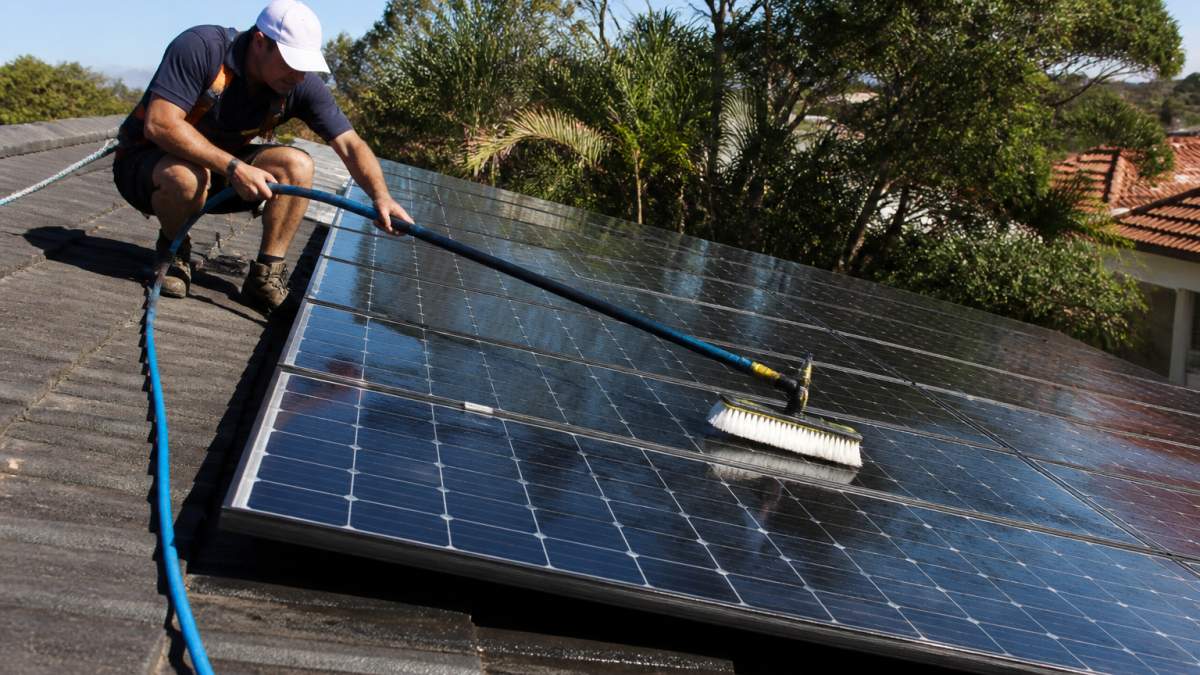
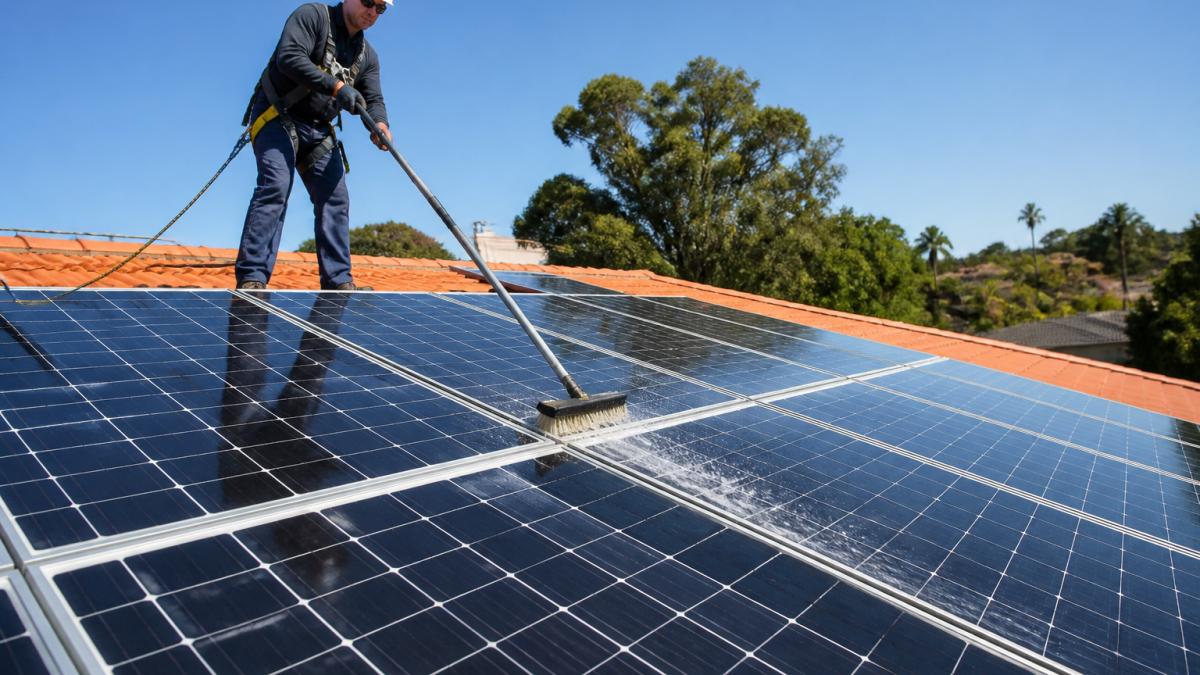
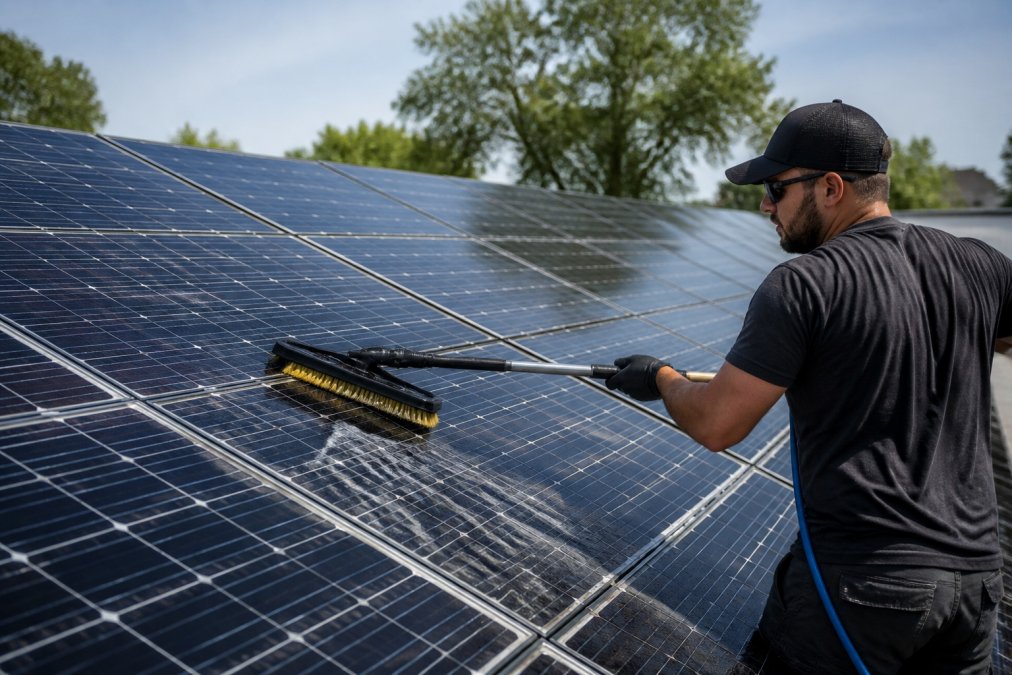
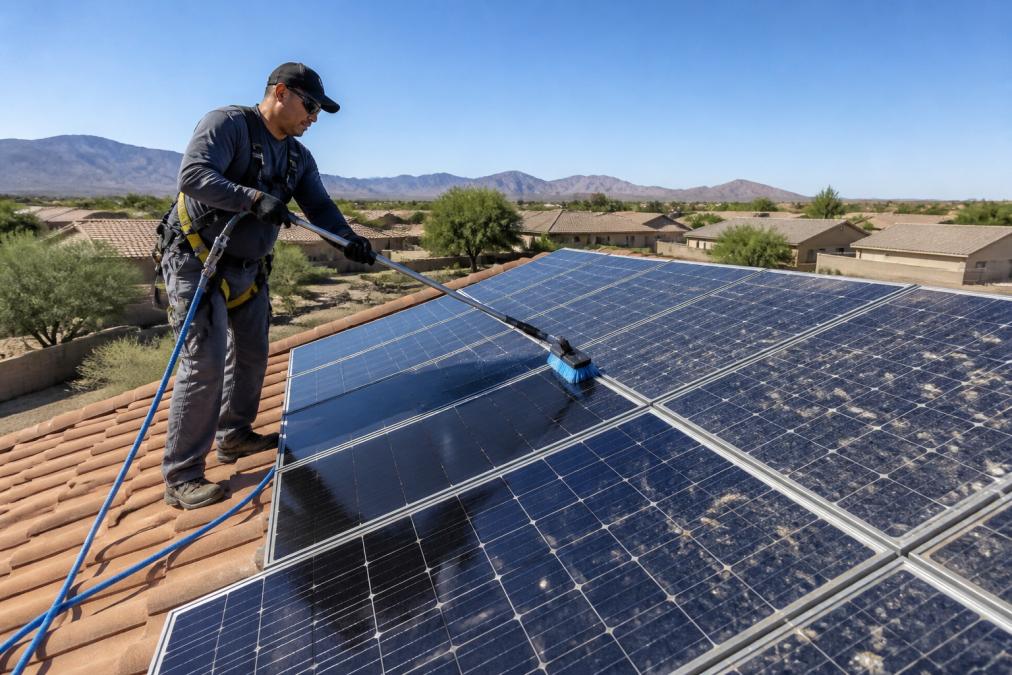
The best tools for cleaning solar panels are a soft-bristle brush, a squeegee, and deionized water. Abrasive materials, pressure washers, and harsh soaps are the fastest way to scratch glass or void your warranty.
DIY Tools and Safety Precautions
If you're cleaning ground-mounted panels or a single-story roof, a basic kit works:
- Soft-bristle brush with an extendable pole
- Squeegee for streak-free drying
- Deionized or purified water
- Safety harness and non-slip footwear for any roof work
- A shutoff check on your system before you start
Never use a pressure washer.
When to Call a Professional
ROI Analysis: Is Professional Solar Panel Cleaning Worth It?
The Cleaning ROI Formula
Payback period (months) = Cleaning cost ÷ Monthly loss.
A Worked Example (Illustrative Numbers)
Why the Before-and-After Report Matters
Micro-Inverter vs. String Inverter: How Configuration Affects Cleaning Impact
Water Quality and Mineral Buildup: Why Deionized Water Matters
Frequently Asked Questions
How do I know if my solar panels need to be cleaned?
Look for visible dust, bird droppings, pollen buildup, or hard water stains on the glass. A drop in energy production monitoring or inverter performance readings also signals soiling loss. If your system output falls below expected kilowatt-hour targets, debris accumulation is likely the cause. Professional inspection can confirm whether cleaning will restore efficiency.
What happens if you don't clean your solar panels?
Neglecting cleaning leads to soiling loss, efficiency degradation, and long-term damage. Bird droppings and mineral deposits can cause micro-cracks or warranty voiding if left untreated. Energy yield drops gradually, and your photovoltaic system may underperform by 20-30% in severe cases. Preventative maintenance protects your investment and maintains ROI.
Can I use tap water to clean my solar panels?
Tap water contains minerals that leave hard water stains and mineral deposits on solar glass. These spots reduce energy production and are difficult to remove without abrasive materials that risk micro-cracks. Deionized water is the safe choice because it dries streak-free and won't void your warranty. Professional services use purified water for this reason.
Is professional solar panel cleaning worth the cost?
Yes, when soiling loss is significant. Cleaning restores system output, and the ROI analysis often shows energy bill reductions that offset the service cost within months. For commercial properties, quarterly cleanings can improve ROI. Homeowners with heavy debris or bird droppings see the fastest payback.
What is the best time of day to clean solar panels?
Early morning cleaning or late evening cleaning is safest. Panels are cooler, which prevents thermal shock from cold water on hot glass. Avoid midday when panels are hottest. Also check that the sun is not directly hitting the array to reduce streaking and allow safe roof access.