 blog
Is Professional Solar Cleaning Worth It?
Quick Summary
Professional solar cleaning is worth it when dirt is measurably cutting your output, such as after heavy bird droppings, agricultural dust, or in dry regions with little rain. Light, even dust is usually handled by rain, so the answer depends on whether the cleaning price is recovered in extra kilowatt-hours.
- Rain clears light dust, so many panels need little cleaning.
- Localized bird droppings can cut output more than a thin, even dust film.
- Clean once or twice a year for most homes; check more often in dry or dusty areas.
- Calculate break-even: cleaning cost divided by monthly kWh gain times your electricity rate.
- Choose professional service for steep, high, or fragile roofs and documented performance reports.
Table of Contents
- Do Solar Panels Actually Need Cleaning?
- How Dirt, Dust, Pollen and Bird Droppings Cut Energy Production
- How Often Should Solar Panels Be Cleaned?
- What Professional Solar Panel Cleaning Costs
- Calculating Your Break-Even Point
- DIY vs Professional Solar Panel Cleaning
- Choosing the Right Solar Panel Cleaning Kit or Service
- Booking Your First Professional Solar Cleaning
- Frequently Asked Questions
Do Solar Panels Actually Need Cleaning?
Solar panels usually need less cleaning than most homeowners expect, but they are not maintenance-free. Rain washes away some dust on its own. Still, grime, pollen, and bird droppings can build up in ways rain does not fix. Dry seasons and agricultural dust are common in parts of Northern California.
The real question is not whether panels get dirty. It is whether that dirt is costing you energy. Most of the time, light soiling has a small effect.
Here is what usually matters:
- Rain often handles light dust. Regular rainfall keeps most panels reasonably clean.
- Dry regions need more attention. Dust and pollen collect faster when it rarely rains.
- Localized debris does the most damage. A bird dropping or leaf can cut output more than an even film of dust.
- Tilt affects how well dirt clears. Flatter panels hold dirt longer than steeply tilted ones.
Watch out: pressure washing can scratch the glass or push water under the frame seals. Always check your manufacturer's cleaning guidance before you start.
How Dirt, Dust, Pollen and Bird Droppings Cut Energy Production
Dirt on a solar panel blocks sunlight from reaching the cells, so less light turns into electricity. The effect depends on what is on the glass and where it sits. A thin layer of dust across the whole panel usually costs less than a small, dense spot in one area.
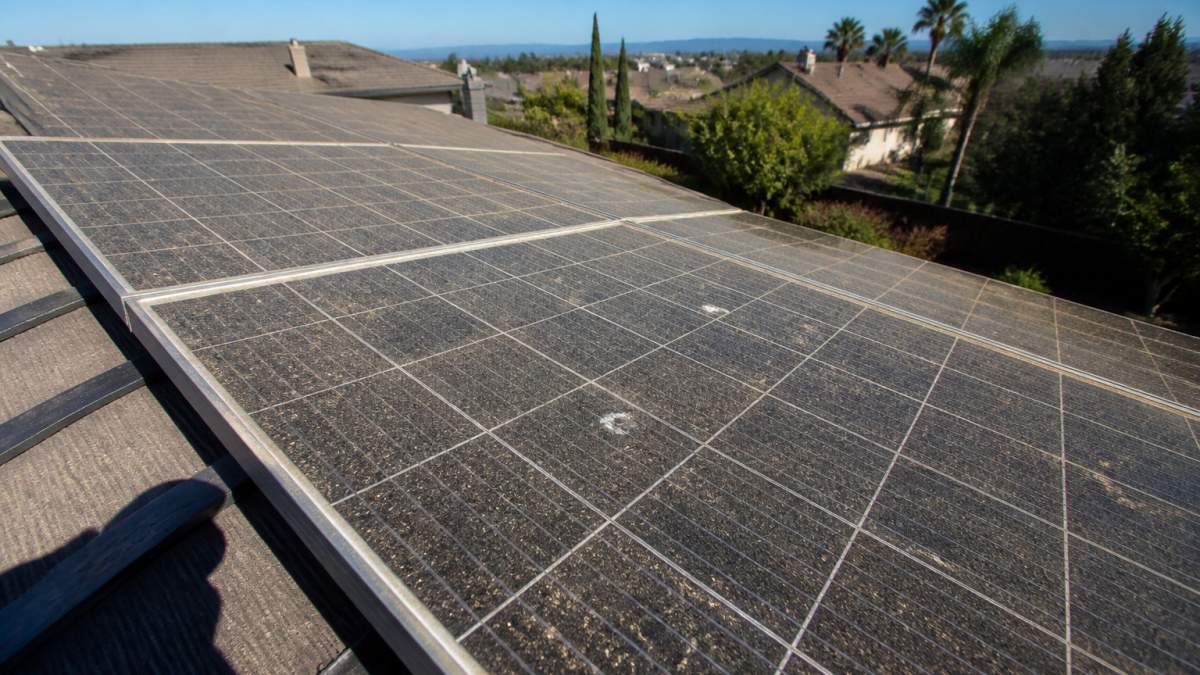
Each type of buildup behaves differently:
- Dust and dirt form a thin, even layer. Rain usually clears most of it.
- Pollen can stick to the glass and form a film, especially during spring bloom.
- Bird droppings create dark, concentrated spots. They can shade whole cell strings and cut output sharply.
- Debris like leaves can block airflow and cover cells for long periods.
Many homeowners assume every dirty panel loses the same share of output. That is not how it works. A panel with one bird dropping in the middle can lose more power than a panel with a faint dust film across its whole surface.
The goal for a homeowner is simple: find the buildup that is actually hurting output, and remove it safely.
How Often Should Solar Panels Be Cleaned?
Most homes do well with cleaning once or twice a year. Dry, dusty areas or properties near trees, farms, or busy roads may need it more often. Commercial sites with many panels often follow a quarterly schedule.
Some useful guidelines:
- Once or twice a year is a common starting point for most homes.
- Every three months suits warehouses and large rooftop systems.
- After heavy bird activity or dust storms, check panels sooner.
- In areas with regular rain, you may need less frequent cleaning.
The best approach is to check your production data. If output drops more than expected for the season, dirt may be part of the cause. Compare monthly production to the same month last year to spot trends.
What Professional Solar Panel Cleaning Costs
Most homeowners searching this question want one thing first: a number.
Residential solar cleaning is typically priced one of three ways:
- Flat per-panel rate. The provider charges a set amount per panel, so a 20-panel array costs roughly twice a 10-panel array. This is the easiest quote to compare across providers.
- Minimum service call. Small systems often hit a floor price because the trip, setup, and water treatment cost the same whether there are 8 panels or 30. Ask whether the minimum applies before you compare per-panel rates.
- Hourly or day rate. More common on commercial rooftops and steep or complex roofs where access eats time. Ask what the clock covers, travel, setup, and water treatment are sometimes billed separately.
What actually moves the price up or down:
- Panel count and system size. More glass means more time, water, and rinse.
- Roof height, pitch, and access. A steep second-story roof or one that needs a lift costs more than a walkable single-story roof. Fall-protection setup adds labor.
- Level of buildup. Heavy bird droppings, agricultural dust, wildfire ash, or sap require more passes and sometimes a pre-treatment.
- Water quality and method. Deionized or reverse-osmosis water and soft-bristle tools cost more to run than a garden hose, but they avoid mineral spotting and scratches.
- Frequency. Recurring plans usually cost less per visit than one-off cleanings because routing and setup are shared.
- Add-ons. Performance reports, before-and-after production readings, gutter clearing, or inspection photos may be included or billed separately.
A written quote should state the per-panel or flat price, whether the minimum applies, what water and tools are used, whether reports are included, and whether the provider carries liability insurance and workers' compensation.
Watch out: a quote that is dramatically lower than others often excludes water treatment, insurance, or fall protection, ask what is left out, not just what is included.
For current pricing on your property, request a written quote from Mr Clean Solar Cleaning; the price depends on panel count, roof access, buildup, and frequency, and the quote should spell out each of those inputs.
The article lays out the main factors that set a professional cleaning price, so the table below sums up how each one affects the quote.
| Pricing factor | Typical effect | Note |
|---|---|---|
| Flat per-panel rate | Cost scales with panel count | Easiest quote to compare |
| Minimum service call | Sets a price floor for small systems | Ask whether it applies |
| Hourly or day rate | Common on commercial or steep roofs | Ask what the clock covers |
| Roof height and pitch | Steeper or higher roofs cost more | Fall-protection setup adds labor |
| Level of buildup | Heavy grime needs more passes | Pre-treatment may be needed |
| Water method | Deionized water costs more to run | Avoids mineral spotting |
| Recurring plans | Lower per-visit cost | Routing and setup are shared |
Calculating Your Break-Even Point
The break-even point is the moment the value of the extra electricity a cleaning recovers equals what you paid for the cleaning.
The formula
Break-even period (in months) = Cleaning cost ÷ (Monthly energy gain in kWh × Your electricity rate in $/kWh)
If the result is shorter than the interval between cleanings, cleaning pays for itself.
The four inputs you need
- Cleaning cost. Use the all-in quoted price, including any minimum call or report fee.
- Expected production gain. The share of output soiling is costing you. This is the hardest input; estimate it from your monitoring data (see controls below) rather than a rule of thumb.
- Your electricity rate. Use the marginal rate you actually pay, including delivery charges, not just the generation rate. If you are on time-of-use pricing, use the rate during the hours your panels produce most.
- System size. Larger systems recover more kWh from the same percentage gain, so the same cleaning cost breaks even faster on a bigger array.
Worked example (illustrative numbers only)
Suppose cleaning costs $300, your panels recover 40 kWh per month, and your all-in rate is $0.30/kWh. Monthly value = 40 × $0.30 = $12.
Controls that keep the result honest
- Compare like months. Production swings with sun angle, day length, temperature, and weather. Compare the same calendar month year over year, or adjacent weeks with similar irradiance, not a sunny week to a cloudy one.
- Normalize for weather. If your monitoring app reports irradiance or a performance ratio, use it; a production jump after a cloudy stretch is weather, not cleaning.
- Separate cleaning from other changes. A firmware update, a new inverter setting, or tree growth can move output too. Change one thing at a time.
- Use several weeks of data. A single day is noise. Two to four weeks on either side of the cleaning gives a fair read.
- Account for the value of your time. If you clean yourself, the break-even math should include the hours and any equipment you bought, not just the water.
When the math usually favors cleaning
Run the formula with your own quote, rate, and a conservative gain estimate before you decide.
DIY vs Professional Solar Panel Cleaning
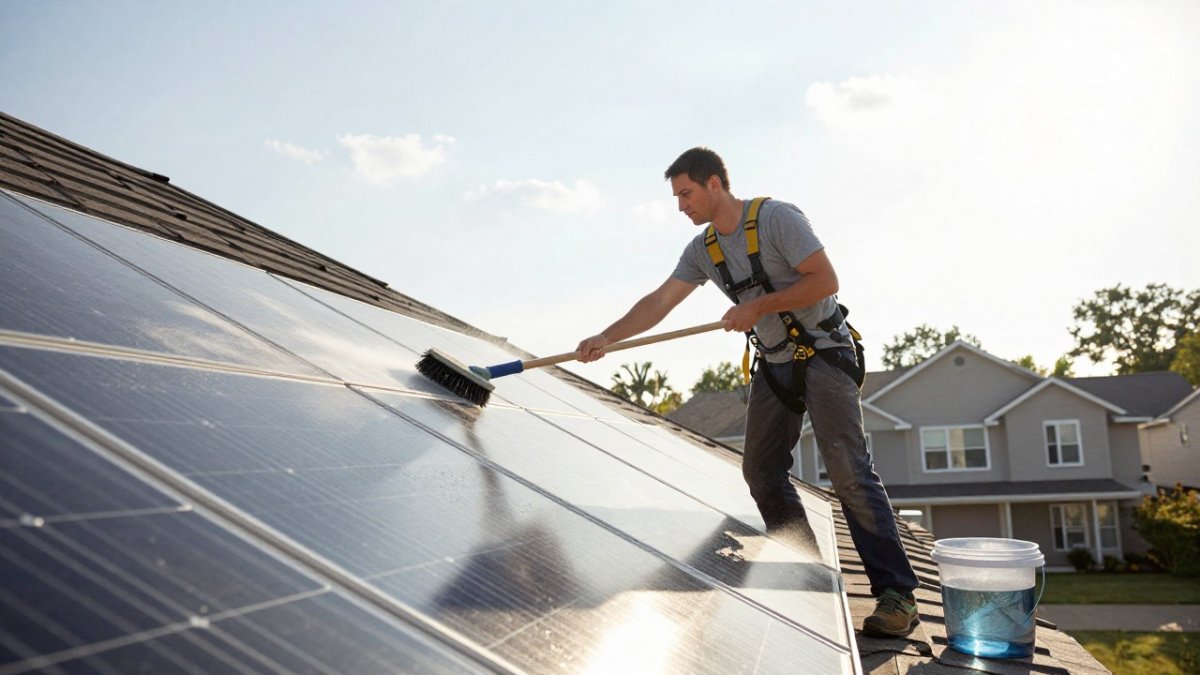
Some homeowners clean their own panels, and that can work if the roof is low, easy to reach, and safe to access. A soft brush, a hose, and deionized water are gentler options than tap water, which can leave mineral spots.
Choose DIY if:
- The panels are on a single-story home and easy to reach from the ground
- You can clean without climbing ladders or walking on the roof
- Your system is small and the buildup is light
Choose a professional if:
- The roof is steep, high, or fragile
- The panels have heavy bird droppings or stubborn grime
- You want documented results or performance reports
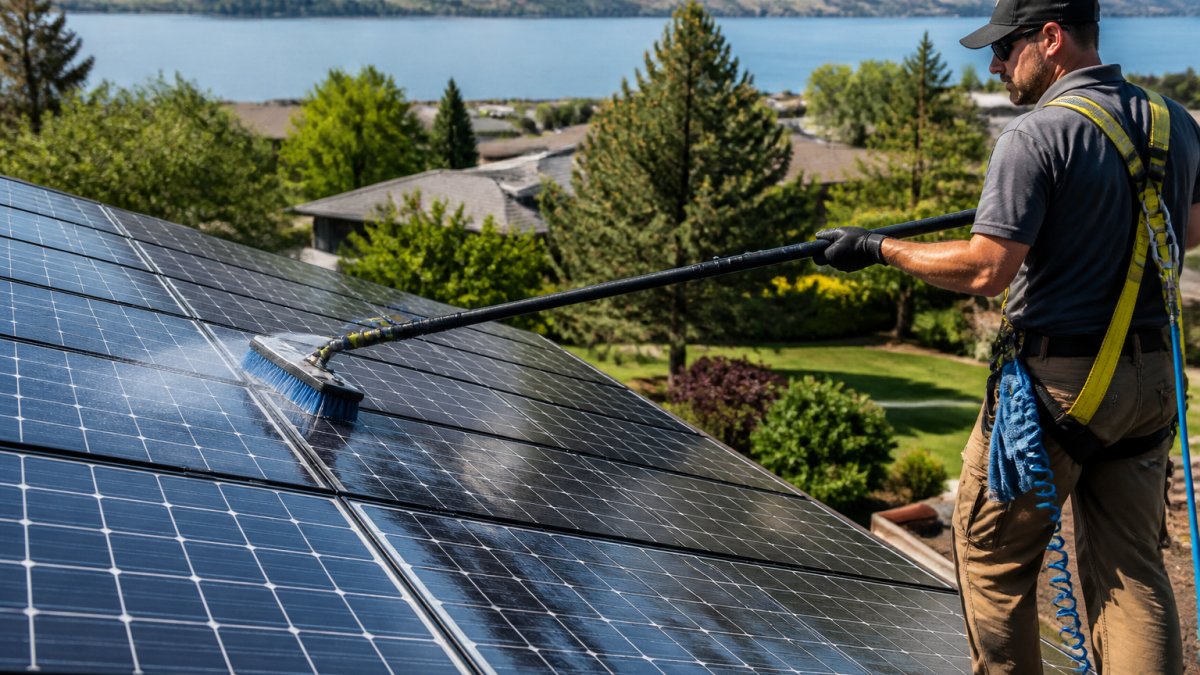
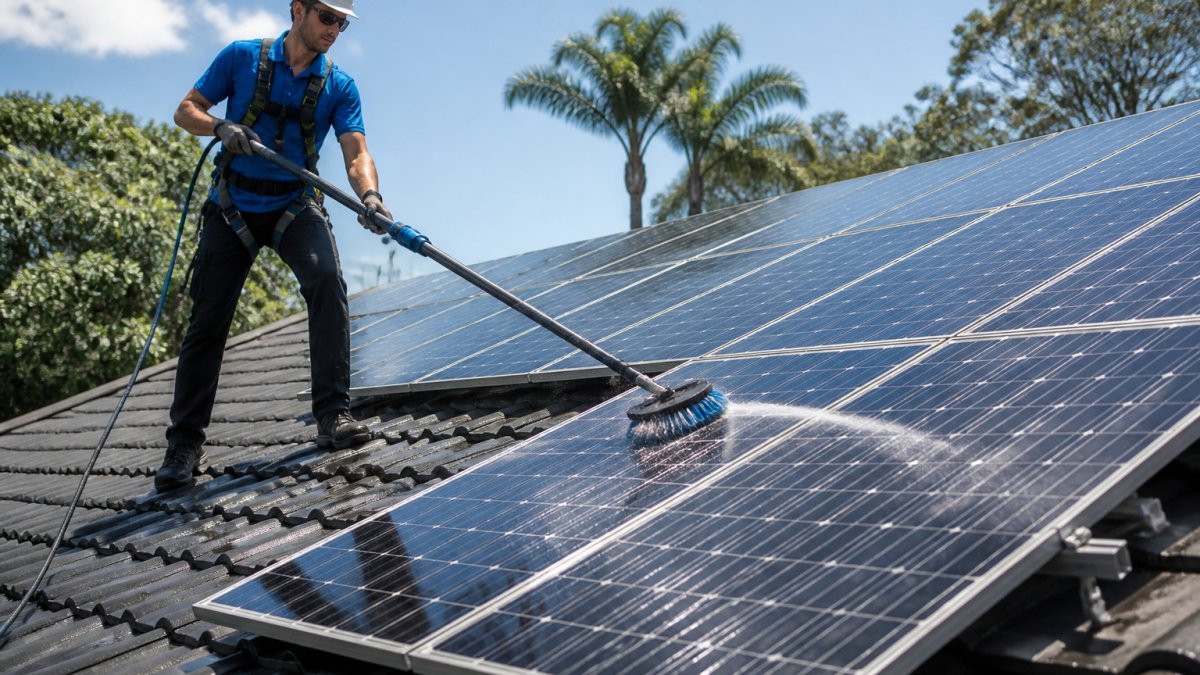
- You want the work insured and done by trained staff
Mr Clean Solar Cleaning's team is OSHA-trained and fully insured, which matters when roof work carries fall risk.
Choosing the Right Solar Panel Cleaning Kit or Service
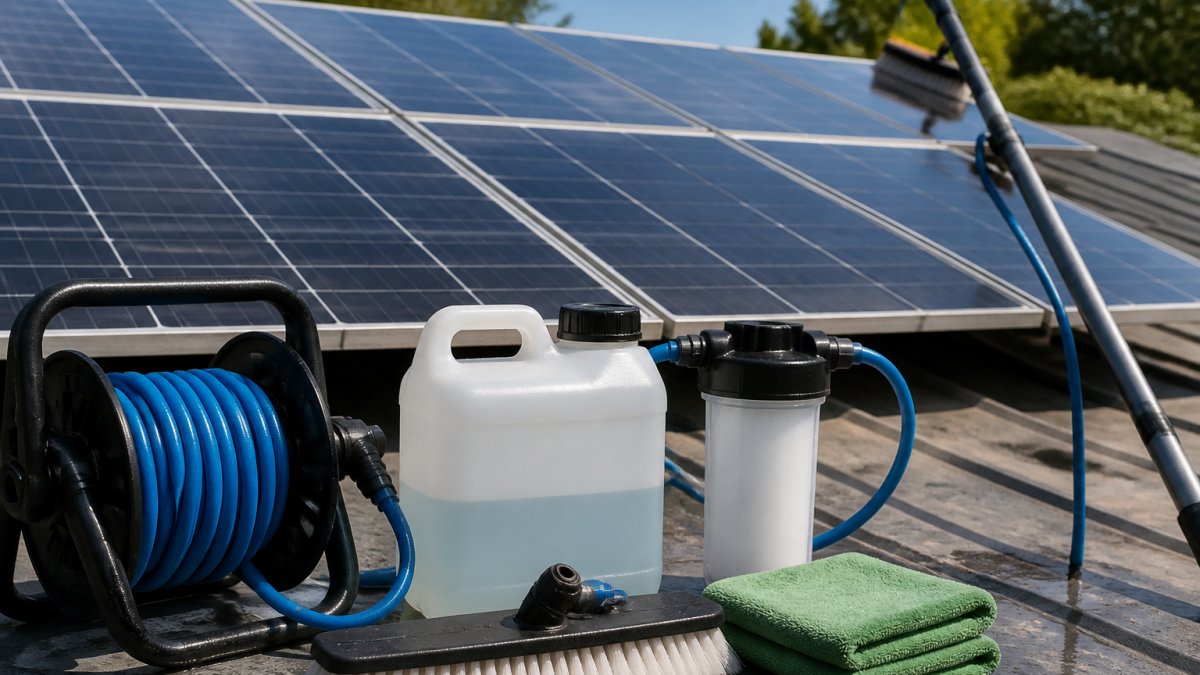
A cleaning kit makes sense for ground-level or low-roof panels that you can reach safely. Look for a telescoping handle, a soft brush or squeegee made for solar glass, and a way to rinse with clean or deionized water. Avoid abrasive scrubbers, harsh chemicals, and high-pressure sprayers.
A professional service makes more sense when:
- Your panels are hard to reach or on a steep roof
- You need regular cleaning on a set schedule
- You want written reports showing production before and after service
- Your property has many panels or a commercial system
When comparing services, ask about insurance, the cleaning method, whether they use deionized water, and what their reports include. Detailed performance reports are available from Mr Clean Solar Cleaning.
Booking Your First Professional Solar Cleaning
Booking is simple. Start by gathering a few details about your system:
- Number of panels and approximate system size
- Roof type and height
- Recent production data, if you have it
- Any known buildup, such as bird droppings or dust
Then contact Mr Clean Solar Cleaning to request a quote and schedule a visit. Ask for a before-and-after report so you can measure the results against your electricity bills.
Contact Mr Clean Solar Cleaning to request a quote and schedule a visit.
Frequently Asked Questions
Does cleaning solar panels really make a difference?
Yes, in many conditions. Dust, pollen, bird droppings and grime block sunlight from reaching the cells, and that lowers output. How much depends on how dirty the panels are, the local climate, and how much rain falls to wash them naturally. Dry, dusty regions and properties near trees or farmland tend to see the biggest gains. The best way to judge is to compare production before and after a cleaning, adjusted for weather and season, rather than relying on a single estimate.
How often should solar panels be cleaned?
Most systems do well with cleaning once or twice a year, though the right schedule depends on soiling. Homes in dry areas, dusty neighborhoods, or under bird roosts may benefit from more frequent cleaning, while areas with regular rain may need it less often. Commercial and utility-scale arrays often follow quarterly schedules. Check your production data for drops that rain does not explain, since that is usually the signal that cleaning is due.
Is professional solar panel cleaning worth the cost?
It can be, if the recovered output and bill savings exceed the service fee over a reasonable period. Start with your annual production, your electricity rate, and the estimated percentage of output lost to soiling. Divide the service cost by the annual savings to find the payback period. Professional cleaning also brings insurance coverage and safe roof access, which matter when panels are hard to reach. Mr Clean Solar Cleaning can provide current pricing and a quote on request.
Is it safe to clean solar panels yourself?
It can be done safely on ground-level or easily reached panels using a soft brush, a low-pressure rinse and deionized water, which leaves no mineral residue. Rooftop work carries real fall risk, and using pressure washers, abrasive materials or harsh chemicals can damage the glass or void warranty terms. Check your manufacturer's cleaning instructions before starting. Professionals are trained in fall protection and carry liability insurance, which is the main reason many homeowners choose them for roof systems.